In one survey of 590 job seekers, 80% said they use AI tools in their search, and 84% use it to edit their resumes — yet 93% worry that AI-written applications make it harder for qualified people to stand out (HRO Today). They're right to worry. When everyone types "write me a resume," everyone gets the same bland, generic result — and recruiters notice.
The winners use AI differently. They give it their real experience, the actual job description and clear instructions, then use it to sharpen, structure and practise. Done this way, it works: a large randomised trial of nearly 500,000 job seekers found that using AI to edit human-written text increased hire rates by about 7.8% (CareerHack).
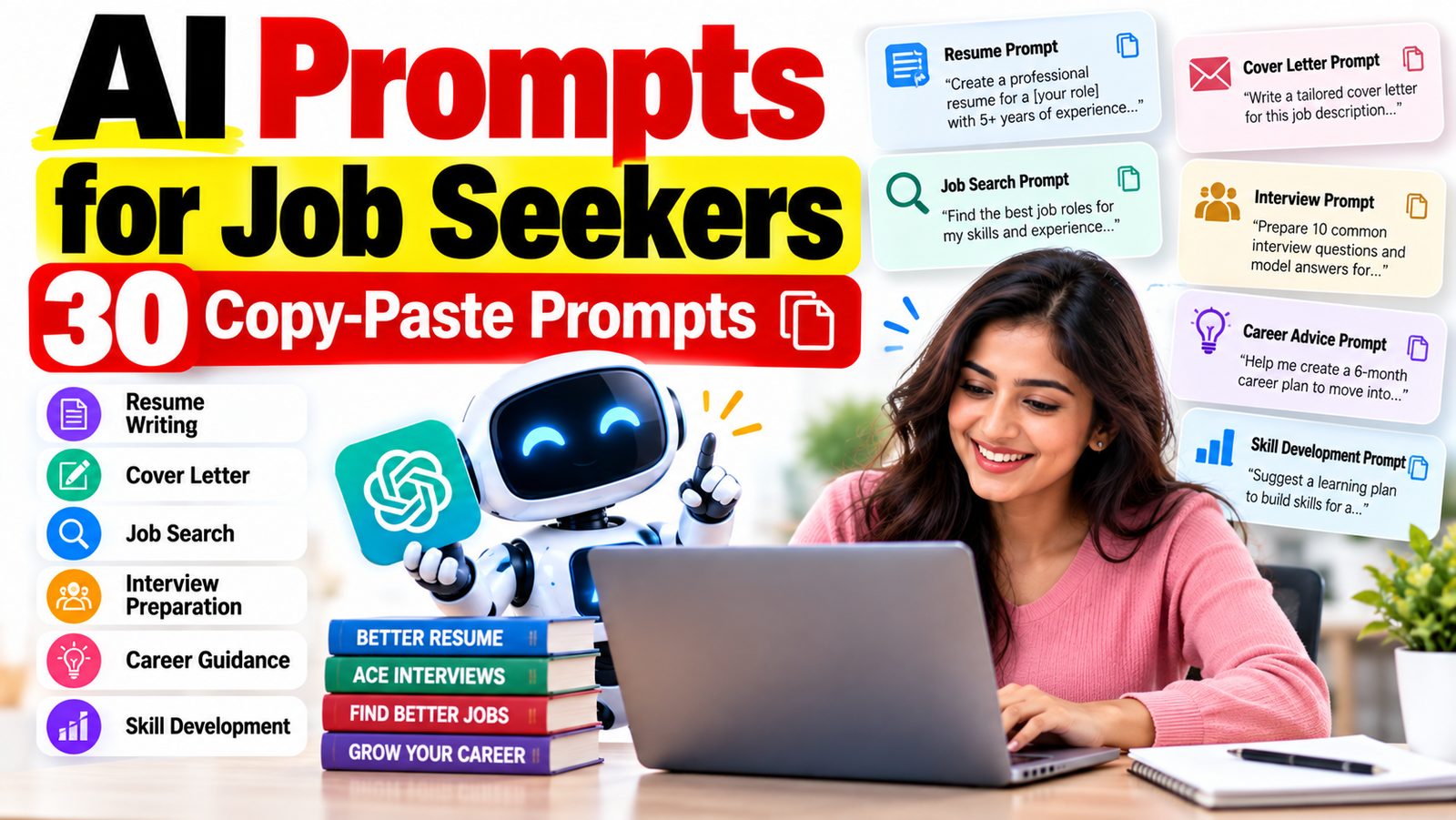
This guide gives you 30 tested, copy-paste prompts covering every stage of the job search: resume, cover letter, LinkedIn, networking, strategy, interviews and salary negotiation. They work in ChatGPT, Claude, Gemini, Copilot or any good AI assistant. Each prompt is built to pull out your specifics, so the output sounds like you, not a robot.
AI can only be as specific as the information you give it. Before using any prompt below, paste this Master Context Block into a new chat once. Every prompt after that will produce sharper, more personal results.
Master contextPASTE ONCE
I'm looking for a job and want your help as an expert career coach and recruiter. Here is my background. Use it for everything I ask in this conversation.
Target role(s): [e.g. Data Analyst / Product Manager]
Target industry and location: [e.g. fintech, Bengaluru or remote]
Years of experience: [e.g. 3 years]
Current / last role: [title, company, dates]
Key achievements (with numbers if possible): [e.g. cut reporting time by 40%]
Skills and tools: [e.g. SQL, Excel, Power BI, Python]
Education and certifications: [degree, college, year; certifications]
Career gap or special situation (if any): [e.g. 1-year caregiving break]
What I want next: [e.g. higher salary, remote work, move into AI]
My current resume is below:
[paste resume text, with phone number and address removed]
Rules for all your answers:
- Never invent experience, numbers or skills I haven't given you. If something is missing, ask me.
- Write in clear, simple, professional Indian English. Avoid clichés like "results-driven", "passionate", "leverage" and "dynamic".
- Be direct and specific, like a senior recruiter giving honest feedback.
Five rules for great results:
Always paste the real job description when a prompt asks for it. Tailoring is where AI saves you the most time.
Fill every [bracket]. The more detail you give, the less generic the output.
Iterate. Reply with "make it shorter," "more confident," "less formal" or "give me three options."
Edit the final version yourself. Add your own words and check every fact. You are responsible for what you submit.
Protect your privacy. Remove phone numbers, addresses, ID numbers and salary slips before pasting anything into AI.
Part 1: Resume prompts (1–8)
1. The brutal resume review
Use this first. It shows you what a recruiter really thinks in the first few seconds.
Prompt#1
Act as a senior recruiter who has reviewed 10,000+ resumes for [target role] roles in India. Review my resume brutally and honestly.
1. What impression do you form in the first 7 seconds?
2. Score it out of 10 for: clarity, impact, relevance to [target role], and ATS-friendliness. Explain each score.
3. List the 5 biggest problems, most serious first.
4. For each problem, show me exactly how to fix it with a before-and-after example using my real content.
5. Tell me what to delete.
Don't be polite. Be useful.
2. Turn duties into achievements
Most resumes list what you were responsible for. Recruiters want what you achieved.
Prompt#2
Here are bullet points from my resume that describe duties, not results:
[paste bullets]
Rewrite each one as an achievement using this formula: Action verb + what I did + measurable result + how or why it mattered.
If a bullet has no number, don't invent one. Instead, ask me a specific question to uncover a real metric (e.g. "How many customers did you handle per day?" or "By how much did the process get faster?"). Then give me 2 versions of each bullet: one with a placeholder for the number, one without.
3. Find your hidden achievements (interview mode)
Perfect if you think "I haven't done anything impressive."
Prompt#3
I struggle to identify my achievements. Interview me like a career coach to uncover them.
Ask me one question at a time about my role as [job title] at [company]. Focus on problems I solved, things I improved, money or time I saved, people I helped, praise I received and things I did beyond my role.
After 8–10 questions, turn my answers into 5 strong, quantified resume bullet points. Do not invent anything I didn't say.
4. Tailor your resume to a specific job
The most important prompt in this guide. Use it for every serious application.
Prompt#4
Here is the job description for a role I'm applying for:
[paste full job description]
Using my resume from earlier:
1. List the top 10 skills and keywords this employer is looking for, in order of importance.
2. Show which ones my resume already covers, which are weak, and which are missing.
3. Rewrite my professional summary for this specific role (3 lines max).
4. Suggest which bullet points to move up, rewrite or remove to match this job.
5. Only include keywords I genuinely have experience with. Flag any gaps I should address honestly in my cover letter or interview instead.
5. The ATS check
Many companies use applicant tracking systems that scan resumes before a human sees them.
Prompt#5
Act as an Applicant Tracking System (ATS) and an expert ATS consultant. Analyse my resume against this job description:
[paste job description]
Give me:
1. An estimated match score out of 100 and why.
2. Missing keywords and the exact section where each should go (only if true for me).
3. Formatting problems that could confuse an ATS (tables, columns, graphics, headers, unusual section names, file type).
4. Standard section headings I should use.
5. A final checklist to make this resume ATS-safe.
6. Write a summary that stops the scroll
Prompt#6
Write 5 different professional summaries for my resume, targeting [target role]. Each must be 2–3 lines and include my years of experience, my strongest specialisation and one quantified achievement.
Make each one a different style:
1. Achievement-led
2. Skills-led
3. Industry-specific
4. Career-changer (if relevant)
5. Short and punchy (under 30 words)
No clichés. It should sound like a confident human, not a template.
7. The career changer's resume
Prompt#7
I'm moving from [current field/role] to [target field/role]. My current resume is written for my old career.
1. Identify my transferable skills and achievements that matter most in [target field].
2. Translate my experience into the language used in [target field] job descriptions.
3. Recommend the best resume format for a career changer (and why).
4. Rewrite my summary and top 6 bullet points for the new field.
5. Suggest 3 short projects or certifications that would make my switch more credible in 60 days.
8. The fresher's resume (no experience? no problem)
Prompt#8
I'm a fresher graduating in [year] with a [degree] from [college]. I'm applying for [target role].
My experience so far: [internships, college projects, hackathons, clubs, volunteering, part-time work, online courses, competitions].
Help me build a one-page resume:
1. Suggest the best section order for a fresher.
2. Turn my projects and activities into achievement-style bullet points.
3. Write a 2-line objective/summary that sounds confident, not desperate.
4. List skills I should add only if I can prove them in an interview.
5. Tell me the 3 things that would most improve my chances in the next 30 days.
Part 2: Cover letters and applications (9–13)
9. The cover letter that doesn't sound like AI
Prompt#9
Write a cover letter for the [job title] role at [company].
Job description: [paste]
Why I genuinely want this role/company: [your real reason, e.g. I use their product, I admire their work in X]
My 2 most relevant achievements: [achievement 1], [achievement 2]
Rules:
- Under 250 words, 3–4 short paragraphs.
- Open with a specific, interesting first line — NOT "I am writing to apply for".
- Connect my achievements directly to the company's needs in the job description.
- Sound warm, confident and human. No clichés or over-the-top praise.
- End with a clear, polite call to action.
10. Research a company in 10 minutes
Works best with an AI that can search the web, such as Perplexity, ChatGPT search, Gemini or Claude with web search.
Prompt#10
I'm applying to [company] for a [role] position. Research the company and give me a one-page briefing:
1. What they do, their main products/services and business model
2. Recent news from the last 6 months (funding, launches, layoffs, leadership changes)
3. Main competitors and how they're different
4. Company culture and values (from their website, reviews and leadership interviews)
5. Likely challenges the team I'm joining faces
6. 3 smart, specific questions I could ask in the interview
Include sources so I can verify each point.
11. Decode a job description
Prompt#11
Here is a job description: [paste]
Read between the lines like an experienced recruiter:
1. What are the 3 must-have requirements vs. nice-to-haves?
2. What problems is this team likely trying to solve by hiring?
3. What does the language suggest about the culture, workload and seniority?
4. Any red flags (unrealistic requirements, vague responsibilities, signs of high turnover)?
5. Based on my background, should I apply? Rate my fit out of 10 and explain.
12. Answer application form questions
Prompt#12
This job application asks: "[paste question, e.g. Why do you want to work here? / Describe a challenge you overcame]"
Word limit: [X words]
Here's my rough answer and the key facts I want to include:
[paste your notes]
Turn this into a clear, specific answer within the word limit. Use my real examples only, keep my voice, and make every sentence count.
13. Explain a career gap or job switch
Prompt#13
I have [a career gap of X months/years due to reason] / [switched jobs frequently: list dates and reasons].
Write:
1. A one-line entry for my resume
2. A 2-sentence explanation for my cover letter
3. A 30–60 second interview answer using this structure: Reason → What I learned or did → Why I'm ready and committed now
Be honest, positive and brief. Don't over-explain or sound apologetic.
Part 3: LinkedIn and networking (14–17)
14. A LinkedIn profile recruiters can find
Prompt#14
Optimise my LinkedIn profile so recruiters searching for [target role] in [city/remote] find and message me.
Using my background, write:
1. 5 headline options (under 220 characters) mixing my role, specialisation, key skills and a result. Not just "Seeking opportunities".
2. An "About" section (around 200 words) in first person: who I am, what I'm great at, 2–3 proof points, and what I'm looking for. Conversational, not corporate.
3. The top 10 skills to add, in order of recruiter search value.
4. 3 ideas for posts I could write this month to show my expertise.
15. The referral request that gets replies
Referrals are one of the fastest ways to get interviews. This prompt writes messages people actually answer.
Prompt#15
Write a short LinkedIn message (under 100 words) asking for a referral or advice.
Who I'm messaging: [e.g. former colleague / alumnus from my college / someone I've never met who works at the company]
Their role and company: [details]
The job I'm interested in: [title + link]
Our connection: [e.g. same college, mutual friend, I read their post on X]
Make it polite, specific and easy to say yes to. Don't ask for a referral in the first line if we don't know each other — ask for 10 minutes of advice instead. Give me 3 versions: very warm, neutral and for a stranger.
16. Message a recruiter or hiring manager
Prompt#16
Write a cold message to the recruiter/hiring manager for the [role] at [company]. Under 80 words.
Include: one line on who I am, one specific result relevant to their job description, and a clear ask (a quick call or a look at my resume). Confident, not pushy. Also write a polite follow-up to send if I don't hear back in 5 working days.
17. Make networking easy for introverts
Prompt#17
I'm an introvert and find networking uncomfortable. I'm attending [event / online community / alumni meet] to find opportunities in [field].
Give me:
1. 5 easy conversation openers that don't feel awkward
2. A 20-second introduction about myself that sounds natural
3. 5 good questions to ask people about their work
4. How to politely end a conversation and stay in touch
5. A follow-up LinkedIn message to send the next day
Part 4: Job search strategy (18–19)
18. Your personal 30-day job search plan
Prompt#18
Create a realistic 30-day job search plan for me. I can spend [X hours] per day/week.
My situation: [employed and looking / unemployed / fresher / career changer]
Target role and location: [details]
Biggest challenge so far: [e.g. no interview calls / failing final rounds / don't know where to apply]
Break it into weekly goals and daily tasks covering: resume and LinkedIn fixes, number of tailored applications, networking messages, skill-building, and interview practice. Include a simple tracker table I can copy into Excel or Google Sheets. Tell me what to measure to know if the plan is working.
19. Diagnose why you're not getting interviews (or offers)
Use this when you've been applying for weeks with poor results.
Prompt#19
I've been job hunting for [X weeks]. Here are my numbers:
- Applications sent: [X]
- Recruiter calls/interview invites: [X]
- Final rounds: [X]
- Offers: [X]
Where I apply: [e.g. Naukri, LinkedIn Easy Apply, company websites, referrals]
Roles and seniority I apply for: [details]
Act as a job search coach. Diagnose where my funnel is breaking (resume, targeting, networking, interviews or negotiation), explain the most likely causes, and give me the 5 highest-impact changes to make this week, in priority order.
Part 5: Interview preparation (20–26)
20. Predict the interview questions
Prompt#20
I have an interview for [role] at [company] ([round, e.g. HR / technical / hiring manager / final]).
Job description: [paste]
Predict the 15 questions I'm most likely to be asked, grouped into: about me, role-specific/technical, behavioural, and questions targeting weak spots in my resume (e.g. gaps, job switches, missing skills). For each, give one line on what the interviewer is really trying to find out.
21. Nail "Tell me about yourself"
Prompt#21
Help me answer "Tell me about yourself" for a [role] interview at [company].
Use the Present → Past → Future structure: what I do now and my key strength, 1–2 past achievements that prove it, and why this role is my logical next step.
Keep it to 60–90 seconds when spoken (about 150–200 words). Make it conversational, not memorised. Give me a version for HR and a slightly more technical one for the hiring manager.
22. Build your STAR story bank
One set of strong stories can answer most behavioural questions.
Prompt#22
Help me build a bank of 6 interview stories using the STAR method (Situation, Task, Action, Result).
Here are rough notes on experiences from my career: [paste 6–8 situations: a problem you solved, a conflict, a failure, leadership, a tight deadline, a big win]
For each story:
1. Write it in STAR format, 60–90 seconds when spoken, with a clear measurable result.
2. List which common questions it can answer (e.g. "conflict with a colleague", "biggest achievement", "a time you failed").
3. Ask me for any missing details instead of inventing them.
23. The mock interview (most powerful prompt)
Practise out loud. Many AI apps have voice mode, so you can speak your answers.
Prompt#23
Run a realistic mock interview with me for [role] at [company], [round type]. You're a tough but fair interviewer.
Rules:
- Ask one question at a time and wait for my answer.
- After each answer, give feedback: score out of 10, what worked, what was weak, and a stronger sample answer.
- Ask follow-up questions like a real interviewer would if my answer is vague.
- After 8 questions, give me an overall assessment: would you move me to the next round? My top 3 strengths and top 3 things to fix.
Start with the first question now.
24. Handle the tough questions
Prompt#24
Give me strong, honest answers for these difficult interview questions, based on my background:
1. What is your greatest weakness?
2. Why are you leaving your current job? [real reason: ...]
3. Why should we hire you over other candidates?
4. Where do you see yourself in 5 years?
5. Why have you changed jobs so often? / Why is there a gap? [if relevant]
For each: what the interviewer is testing, a 45–60 second answer, and one mistake to avoid. Make the weakness genuine (not "I'm a perfectionist") with a clear improvement plan.
25. Prepare for a technical or case interview
Prompt#25
I have a technical/case interview for [role]. Key skills listed: [e.g. SQL, Python, system design, guesstimates, product sense, financial modelling].
1. Create a 7-day prep plan focusing on the most likely topics.
2. Give me 10 practice questions, from easy to hard, typical of Indian [company type: product startup / IT services / Big 4 / bank / GCC] interviews.
3. Don't show the answers yet. I'll answer one by one; then evaluate my approach, correct mistakes, and explain the ideal solution step by step.
26. Smart questions to ask the interviewer (and the thank-you note)
Prompt#26
1. Suggest 8 thoughtful questions I can ask at the end of my interview for [role] at [company], tailored to [round: HR / hiring manager / senior leader]. Avoid questions I could answer with a Google search.
2. Then write a short thank-you email (under 120 words) to send within 24 hours, mentioning [one specific thing we discussed] and briefly reinforcing why I'm a strong fit.
Part 6: Offers, salary and your first 90 days (27–30)
27. Decode your offer: CTC vs in-hand salary
Prompt#27
I've received a job offer. Here is the CTC breakup: [paste components, e.g. basic, HRA, special allowance, PF, gratuity, variable pay, joining bonus, ESOPs, insurance].
City: [city]. Tax regime I plan to use: [old/new/not sure].
1. Explain each component in simple terms and which parts I actually receive monthly.
2. Estimate my approximate monthly in-hand salary and show your working. Flag that it's an estimate.
3. Point out anything unusual or worth questioning (e.g. high variable pay, clawback clauses, ESOP vesting, notice period, bond).
4. List questions I should ask HR before accepting.
Always confirm final take-home figures with HR or a tax professional.
28. Negotiate your salary with confidence
Prompt#28
Help me negotiate my job offer.
Role and company: [details]
Offer: [CTC and breakup]
My current CTC: [X] | My expectation: [Y] | Notice period: [X days]
My leverage: [e.g. other offers, rare skills, strong interview feedback, market research]
1. Estimate whether my expectation is reasonable and how to research the market range (e.g. AmbitionBox, Glassdoor, LinkedIn Salary, peers).
2. Write a polite, confident negotiation email.
3. Write a phone script, including how to respond if they say "This is our best offer" or "We can't match your expectation."
4. Suggest non-salary items to negotiate if base pay can't move (joining bonus, notice buyout, remote days, title, review in 6 months).
29. Compare two offers
Prompt#29
I have two job offers and can't decide.
Offer A: [company, role, CTC, in-hand estimate, location, work mode, growth, team, stability, learning]
Offer B: [same details]
What matters most to me right now: [e.g. learning, money, stability, work-life balance, brand]
Create a weighted decision table, explain the trade-offs honestly, and tell me which questions would help me decide. Don't choose for me until I've answered them.
30. Win your first 90 days
Getting the job is the start. A strong first 90 days sets up your next raise and promotion.
Prompt#30
I'm starting as a [role] at [company] on [date]. My manager's top priorities seem to be: [what you learned in interviews].
Create a 30-60-90 day plan:
- Days 1–30: learn (people to meet, things to understand, quick wins)
- Days 31–60: contribute (first projects, how to show early impact)
- Days 61–90: lead (bigger initiatives, how to measure success)
Include questions to ask my manager in our first 1:1, and a simple way to track and report my achievements so they're ready for my first appraisal.
Do's and don'ts: use AI without hurting your chances
Recruiters don't object to AI polishing a resume; they object to AI hiding a lack of skills. In one US survey of 600 hiring managers, nearly 20% said they would reject a candidate who used an AI-generated resume or cover letter, and they were most opposed to AI use during skills assessments (US Chamber of Commerce). Use AI as a coach and editor, not a ghostwriter.
Do
Don't
Feed AI your real achievements, numbers and stories
Let AI invent experience, skills or metrics
Tailor each application to the job description
Mass-apply with the same AI-written resume
Rewrite the final draft in your own voice
Submit AI output without reading it
Use AI to practise interviews out loud
Use AI to answer live interviews or tests for you
Remove personal details before pasting
Paste Aadhaar, PAN, phone numbers or payslips
Verify every fact, number and company detail
Trust AI-generated salary or company "facts" blindly
How to spot AI-sounding text in your draft: look for overused words like "leverage", "spearheaded", "dynamic", "passionate", "results-driven" and "in today's fast-paced world"; every bullet the same length; and claims that could apply to anyone. Replace them with specific tools, numbers, names of projects and plain language. If your best friend couldn't tell it was about you, rewrite it.
Start here: your 3-prompt quick win
Don't try all 30 at once. If you only have one hour today, do this:
Paste the Master Context Block.
Run Prompt 1 (Brutal Resume Review) and fix the top three problems.
Run Prompt 4 (Tailor to a Job) for the one role you want most, then apply.
Tomorrow, spend 20 minutes on Prompt 23 (Mock Interview). Repeat daily until your answers feel natural.
AI won't get you the job on its own. But used well, it gives you a tireless career coach, editor and interview partner — for free. The candidates who win in 2026 will be the ones who combine AI's speed with their own real stories.
Once your content is ready, build a clean, ATS-friendly resume in minutes on ResumeMinter — free. Bookmark this page and share it with a friend who's job hunting.