Background Verification in India: What Companies Check and Why Offers Get Revoked
You've cleared every interview round, negotiated your salary and accepted the offer. Then an email arrives from a verification agency asking for documents, references and consent. For many candidates, this is the most nerve-wracking stage of hiring — and for some, it's where an offer quietly disappears.
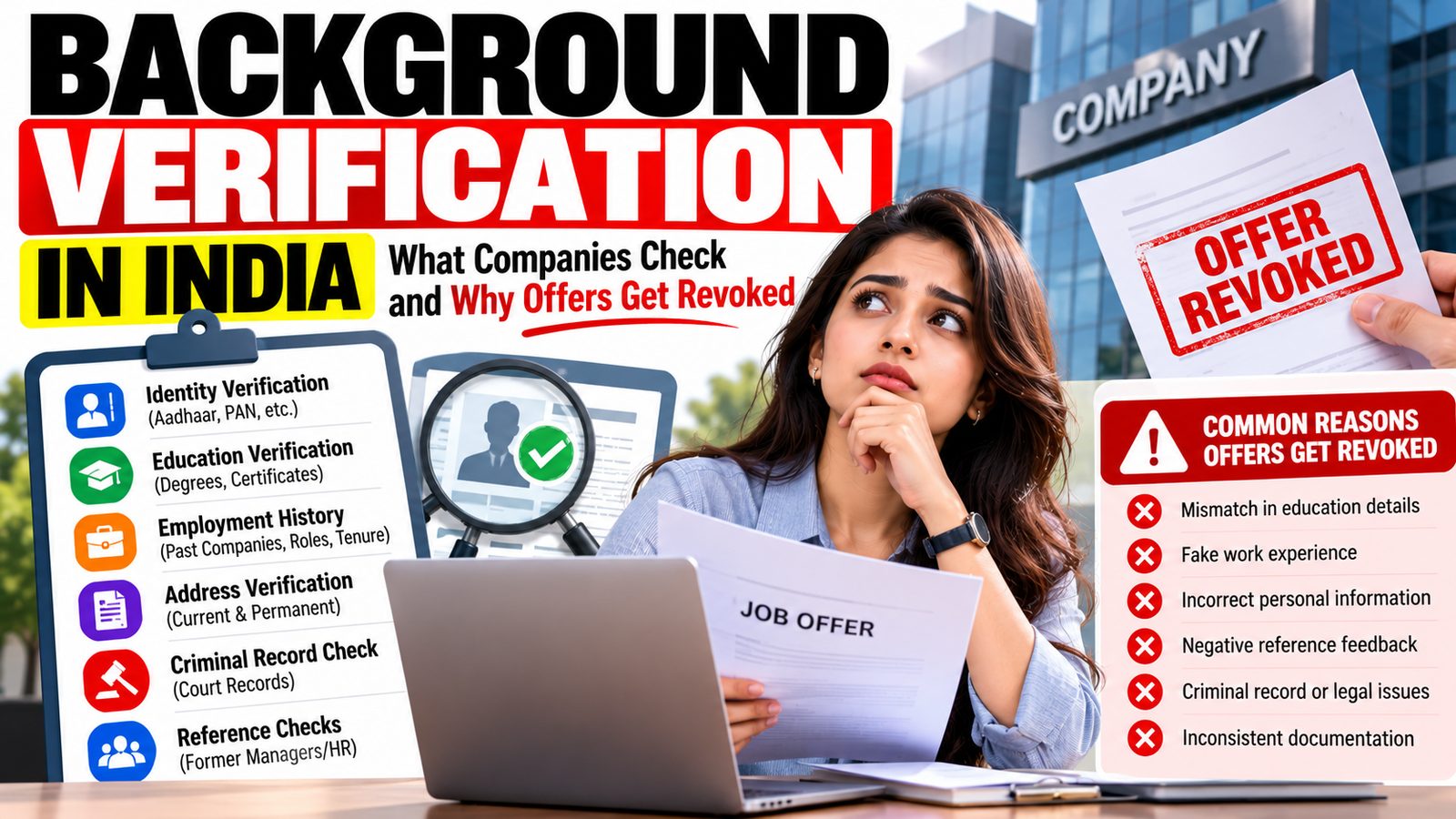
Background verification (BGV) is now standard at most Indian companies, especially in IT, banking, consulting and global capability centres. And it does catch problems: India's largest verification firm, AuthBridge, found that 11.15% of white-collar employment checks in the first half of FY26 showed discrepancies, along with 7.68% of address checks and 4.49% of education checks (Storyboard18).
The good news: most honest candidates pass without trouble, and many "discrepancies" are fixable paperwork problems rather than lies. This guide explains how BGV works, exactly what companies check, why offers get revoked, your rights, and how to make sure your verification goes smoothly.
How background verification works
Most companies outsource BGV to specialist agencies such as AuthBridge, First Advantage, HireRight or OnGrid. A typical process takes 7–15 business days (ePeople India), though it can take longer if a previous employer or university is slow to respond.
- Consent and form. You receive a BGV form or portal link and sign a consent authorising the checks.
- Document upload. You submit ID, address proof, educational certificates, offer and relieving letters, payslips, and reference contacts.
- Verification. The agency contacts previous employers' HR, universities and boards, checks address (sometimes by field visit or digital location confirmation), and searches court and police records.
- Report. The agency sends the employer a report, usually colour-coded:
| Status | Meaning | What usually happens |
|---|---|---|
| Green / Clear | Everything matches | You join as planned |
| Amber / Insufficient | Minor mismatch or information not yet verifiable (e.g. a former employer hasn't replied) | HR asks you for clarification or more documents |
| Red / Discrepancy | A material mismatch, such as fake documents, undisclosed employment or false dates | Offer may be put on hold or revoked, or employment terminated if you've already joined |
Pre-joining vs post-joining. Some companies complete BGV before your joining date; many start it at offer acceptance and finish after you join. Offer letters and employment contracts usually state that your employment is conditional on satisfactory verification, so a red flag can lead to termination even after you've started work. Read that clause before you resign from your current job.
What companies actually check
| Check | What's verified | How |
|---|---|---|
| Identity | Name, date of birth, photo, PAN, Aadhaar | ID databases and document checks |
| Employment history | Company names, dates of joining and leaving, designation, sometimes salary and reason for leaving, eligibility for rehire | Previous employers' HR, relieving and experience letters, payslips — and increasingly EPFO/UAN records |
| UAN / EPFO service history | Which employers paid your provident fund and for which months | EPFO records, with your consent |
| Education | Degree, university, year of passing, marks; whether the institution is genuine and recognised | Universities and boards directly, or digital records such as DigiLocker |
| Address | Current and permanent address | Field visit, postal check or digital location confirmation |
| Criminal and court records | Pending or past criminal cases | Court record searches (e-Courts) and sometimes police verification |
| References | Your performance and conduct | Calls to managers or colleagues you list |
| Credit (role-specific) | CIBIL score and defaults | Usually for banking and finance roles, using your PAN |
| Others (role-specific) | Professional licences, global sanctions and media checks, drug tests in some industries | Specialist databases |
The UAN check deserves special attention. Your Universal Account Number links all your PF contributions across employers, so a UAN check maps out your real employment timeline. If contributions come from two companies in the same months, that's dual employment, visible directly in the data (OnGrid). UAN data doesn't confirm job titles, though, and only covers PF-paying employment in India, so agencies still contact HR for the rest.
Your salary claims can be checked too. Payslips, Form 16 and HR confirmations can reveal an inflated CTC, and AuthBridge lists inflated salaries among the main reasons employment checks fail (AuthBridge). If you've told a recruiter a higher current salary than your documents show, expect questions.
How often candidates get flagged — and where
AuthBridge's Workforce Fraud Files reports give the clearest picture of BGV outcomes in India. In H1 FY26 (April–September 2025), it found an overall discrepancy rate of 4.33% among white-collar employees (MediaBrief). In other words, the vast majority of candidates pass.
Where problems show up (white-collar, H1 FY26)
| Check | Discrepancy rate |
|---|---|
| Employment verification | 11.15% |
| Address verification | 7.68% |
| Education | 4.49% |
| References | 4.17% |
Employment discrepancies by industry: Retail 16.37%, Telecom 14.32%, Banking & BFSI 13.00% and Pharma 12.10% (Storyboard18).
In its previous report, covering October 2024 to March 2025, AuthBridge found that employment checks failed mainly because of inflated salaries, fabricated work experience and contract violations, while education discrepancies were driven by fake certificates and degrees from blacklisted institutions. IT/ITES had an overall discrepancy rate of 9.46%, and the report noted 5% dual employment in the sector, especially in remote roles (SME Street).
The takeaway: employment history is where most candidates get into trouble — and it's also the area most within your control.
Why offers get revoked: the 10 most common reasons
Serious (often lead to revocation or termination)
- Fake or purchased degrees and certificates, or degrees from unrecognised or blacklisted institutions.
- Fake experience — companies that don't exist, or roles you never held. Some candidates buy fake experience letters from "consultants"; agencies routinely catch these.
- Hidden dual employment or moonlighting. UAN checks show overlapping PF contributions from two employers, which usually breaches employment contracts. KPMG's forensic team reported that around 80% of employees admitted to moonlighting in interviews after an initial UAN check flagged them (KPMG).
- Hiding a past employer, for example dropping a job you were fired from. UAN records often reveal it.
- Inflated salary or designation that payslips or HR contradict.
- Undisclosed criminal cases where the role or company policy requires disclosure.
Fixable (usually lead to amber flags and questions)
- Date mismatches — rounding "March 2023" to "January 2023" or stretching tenures to hide a gap.
- No relieving letter or "absconding" status from a previous employer, often after leaving without serving notice.
- Unreachable references or a former employer that has shut down or won't respond.
- Name or date-of-birth mismatches across documents, or address checks failing because you've moved.
Why employers react strongly: offer letters usually make employment conditional on satisfactory BGV, and many companies treat any deliberate misrepresentation as a breach of trust, even if the lie seems small.
Your rights during background verification
BGV is legal in India, but it now sits within the country's first comprehensive data protection law. The Digital Personal Data Protection (DPDP) Act was passed in August 2023, and its Rules were notified in November 2025 and are being rolled out in phases through 2026 (OnGrid), with full enforcement expected by May 2027 (Avvanz).
What this means for you as a candidate:
- You should be asked for clear consent. In practice, reputable employers and agencies take explicit consent before running checks, and BGV vendors describe consent as the foundation of DPDP-compliant verification (AuthBridge). Lawyers note the Act also allows some processing for legitimate employment purposes (IBA), so the exact legal position is still being worked out.
- You can know what's being checked and why. A good consent form explains the checks, the agency involved and how your data will be used.
- You have rights over your data, including access, correction and grievance redress, and you can withdraw consent — though withdrawing may affect your offer (OnGrid).
- The employer stays responsible for your data even when an agency does the checks (The People's Board).
Practical rights you can use today
- Ask HR which checks will be run and which employers or references will be contacted.
- Ask that your current employer not be contacted until after you resign; most companies agree.
- If a check comes back amber or red, ask what the specific discrepancy is so you can respond.
- Share only what's needed: blur unnecessary details (such as bank account numbers on payslips) if the employer allows.
This is general information, not legal advice. For disputes, consult a lawyer familiar with employment and data protection law.
How to prepare and pass BGV smoothly
Before you apply anywhere
- Check your own UAN service history on the EPFO member portal. Make sure every employer and date matches your resume, and fix errors (such as wrong exit dates) with your previous employer's HR.
- Make your resume match your documents exactly — company legal names, designations and month-year dates as shown on offer and relieving letters.
- Never hide a job. If you worked somewhere for three months, list it, or be ready to disclose it on the BGV form; UAN will show it anyway.
- Show career gaps honestly rather than stretching dates.
Keep a BGV document kit ready
- PAN, Aadhaar and passport (if any)
- Class 10 and 12 mark sheets, degree certificates and final mark sheets, and provisional certificates if the degree isn't issued yet
- Offer letter, appointment letter, relieving letter and experience letter for every employer
- Last three payslips for each employer, plus Form 16s
- Current address proof
- Two or three reference contacts per job who know your work, with their permission
When you get the BGV form
- Fill it in yourself, slowly; most problems start with a hurried form.
- Declare everything the form asks for, including short stints, gaps and any pending cases.
- Brief your references so they expect the call.
- Respond quickly to agency emails and calls, and keep your phone reachable.
- If a former employer has shut down, tell HR upfront and offer alternatives: payslips, Form 16, bank statements showing salary credits, and UAN records.
If your BGV comes back amber or red
Don't panic, and don't go silent. Many flags are resolved with a quick explanation and the right documents.
- Ask exactly what was flagged. Request the specific discrepancy from HR in writing.
- Respond quickly and calmly with an explanation and supporting proof.
- Match the fix to the problem:
| Flag | What to provide |
|---|---|
| Date mismatch | Offer and relieving letters, first and last payslips, UAN passbook |
| Former employer unresponsive or closed | Payslips, Form 16, bank statements, UAN history, a colleague reference |
| No relieving letter / absconding status | Your resignation email, proof of handover and any notice-buyout payment; ask the old employer's HR to update the status, settling dues if needed |
| Education not yet verifiable | Provisional certificate, final mark sheet, university verification receipt |
| Address not verified | Updated address proof and availability for a field visit |
| Undisclosed short job | Honest explanation of why it was omitted plus its documents |
- If you made a mistake, own it. A candid, documented explanation for an honest error is far more likely to save an offer than defensiveness.
- If the finding is wrong, ask the agency or employer to correct it with your evidence. Under data protection law you also have the right to request correction of inaccurate personal data.
- Don't resign from your current job until BGV is clear or the employer confirms in writing that pending checks won't affect your joining. This is the single best protection against being left with no job.
If an offer is revoked anyway, ask for the reason in writing, keep all correspondence, and learn from it before your next application. For contract or legal disputes, speak to an employment lawyer.
Quick checklist
- Resume dates, company names and designations match your letters exactly
- UAN service history checked and errors fixed
- Every job, including short ones, ready to disclose
- Gaps shown honestly, not hidden
- BGV document kit ready, including relieving letters and payslips
- References briefed
- Salary claims match your payslips
- Not resigning until BGV is cleared or confirmed safe in writing
The bottom line: background verification isn't designed to trap honest candidates — most people pass. It catches inconsistencies, and the easiest way to pass is to make your resume, documents and records tell the same story. Start with an accurate, well-structured resume: build one free on ResumeMinter.