Campus Placement Reneging: Rules and Consequences
You accepted a campus placement offer months ago. Now a better one has appeared — higher pay, a dream company, a role that fits you better — or your plans have changed: higher studies, a government job, family reasons. Can you walk away? And what happens if you do?
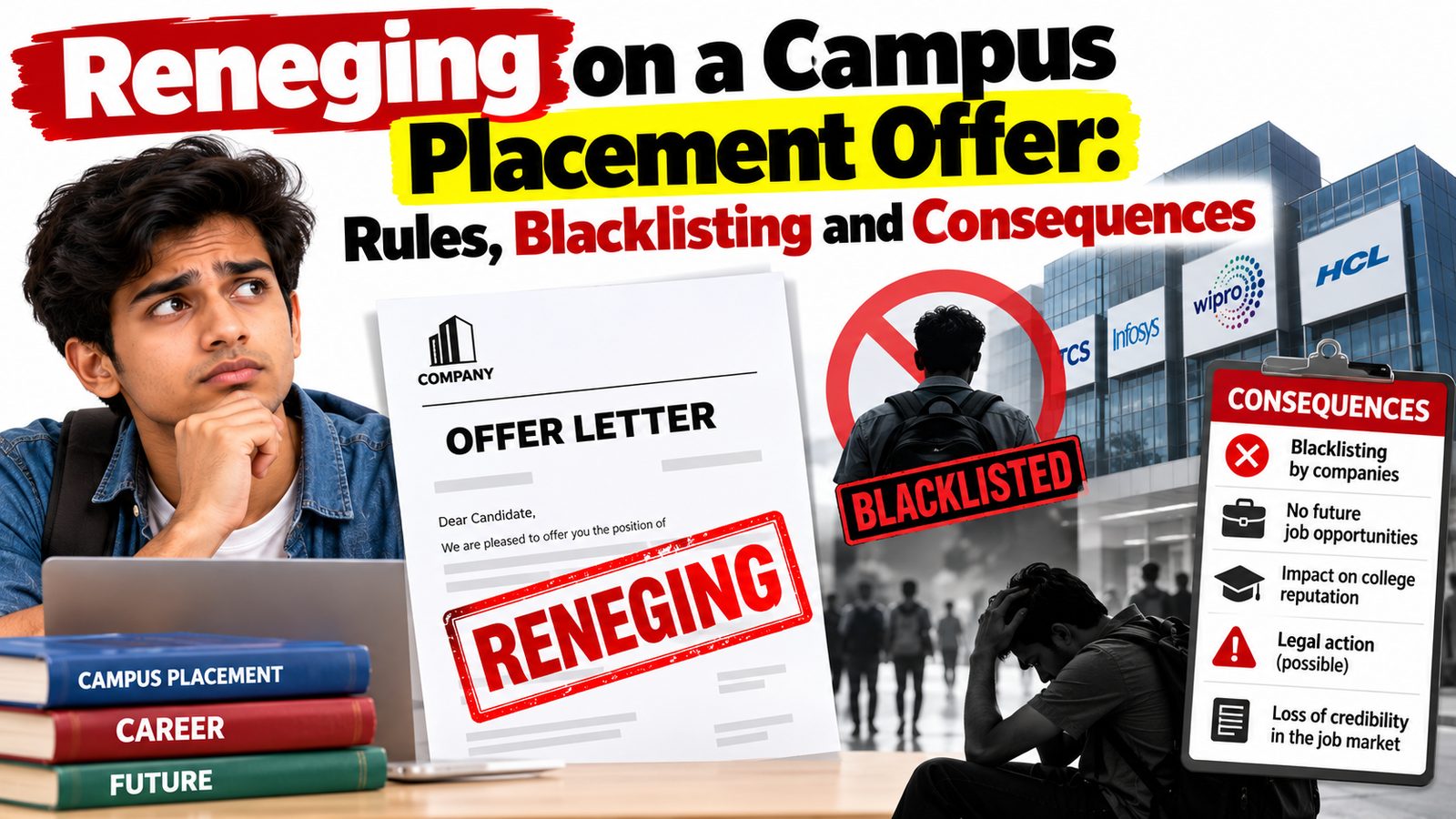
This is one of the most stressful decisions final-year students face, and the stakes go both ways. In September 2026, the IITs' All India Placement Committee decided to enforce a two-year period of "non-cooperation" against 22 companies, including Oracle, after they failed to honour more than 150 offers made to graduating students (Business Today). Colleges punish students who back out, too.
This guide explains what reneging means, the placement rules most Indian colleges follow, the real consequences for students, when backing out is understandable, how to do it with the least damage — and what to do when it's the company that reneges on you.
What "reneging" means
Reneging means backing out after you've accepted an offer — for example, not joining because you've accepted another job, decided to study further, or changed your plans. It's different from declining an offer before accepting it, which is usually allowed.
In campus placements, the line is often drawn earlier than students expect. At many institutes, simply receiving an offer counts as being placed, whether or not you accept it. IIT Goa's policy, for instance, treats a student who gets an offer from any company as placed under its one-student-one-job rule, regardless of acceptance (IIT Goa).
Why colleges take it so seriously: when a student backs out, the company loses a hire it planned for, and its recruiters may hire fewer students — or stop visiting — the following year. Every renege can cost future batches opportunities.
The placement rules most Indian colleges follow
Every institute writes its own placement policy, but most share a common structure. Read yours before you sit for your first company.
One student, one job. Most IITs, NITs and many private colleges follow this rule: once you get an offer, you can't take part in further placements. NIT Srinagar, for example, states that a student who gets a job is not allowed to participate further in the placement process (NIT Srinagar).
Dream or upgrade options. Many colleges allow a limited second chance. At NIT Srinagar, a student with an offer can apply to a "dream company" whose package is higher, but must give up the first offer if selected — and can use this only after 60% of students are placed (NIT Srinagar). IIT Palakkad uses a CTC threshold: offers of ₹10 lakh or more end your placement season, while students with lower offers have further options (IIT Palakkad).
PPOs count as jobs. Pre-placement offers from internships are usually treated as a placement. At IIT BHU, a PPO counts as a job unless you reject it within two working days, and failing to report a PPO can get you debarred (IIT BHU).
Exceptions for PSUs and higher studies. Some institutes allow students to take a PSU job over a private offer (IIT Goa), and many accept higher studies as a valid reason if you inform the placement cell early. VJTI, for example, asks students to inform the cell by the end of April with the university's offer letter (VJTI).
Signed undertakings. Some colleges make every student sign an undertaking before placements that spells out penalties for not joining (Careers360).
The real consequences for students
| Consequence | What it looks like | How likely |
|---|---|---|
| Debarred from campus placements | You're removed from the placement process for the rest of the season | Very common; written into most policies. IIT Goa debars students who breach its rules and considers further penalties (IIT Goa) |
| Blacklisted by the placement cell | Barred from future campus processes; some colleges let you appeal to the placement committee (VJTI) | Common |
| Financial penalty | IIIT Allahabad's 2025–26 rules set a penalty of two months of the offered CTC for not joining a full-time job after accepting it, and three months' stipend for internships (Careers360) | Some institutes |
| Disciplinary action | NIT Srinagar notes violations can lead to debarment and disciplinary proceedings (NIT Srinagar) | Some institutes |
| Company records | The company may note you as ineligible for rehire for some time | Possible, especially with large recruiters |
| Reputation | Placement officers, seniors and recruiters remember; references may suffer | Real, though hard to measure |
What about legal action? Companies very rarely take students to court over a campus offer, and a simple offer letter usually isn't a strong basis for one. The bigger risk is a service agreement or training bond signed at joining. Read anything you sign carefully.
What about withholding your degree? Your college's penalties are governed by its own rules. If a penalty seems disproportionate — for example, a threat to withhold your degree — ask for the rule in writing and raise it through the dean of students or grievance cell.
When backing out is understandable
Not every renege is equal. Placement cells and companies are usually more understanding when the reason is genuine and you act early.
Usually accepted, if you follow the process:
- Higher studies — admission to a master's, MBA or PhD, with proof, informed before the college's deadline.
- Government or PSU job — many policies make an explicit exception.
- Serious health or family reasons.
Grey areas:
- The company keeps delaying your joining date. Many students wait months without a firm date. Ask the company and placement cell for written clarity; if delays drag on, your college may allow you back into placements or support you in taking another job.
- Major changes to the offer — a lower CTC, a different role or location than promised, or a new bond you weren't told about.
Hardest to justify:
- A slightly better package elsewhere after you accepted, without using your college's dream or upgrade option.
- Accepting multiple offers and choosing later — this is what campus rules are designed to prevent.
If you're in a grey area, talk to your placement officer before you act. Many problems can be resolved inside the rules.
If you must back out: how to do it with the least damage
- Read your college's placement policy and anything you signed. Know the exact penalty before you decide.
- Talk to your placement officer first. Explain your reason honestly and ask about the process. Many policies require that all communication with the company go through the placement cell (VJTI).
- Get your new plan confirmed in writing — the new offer letter or university admission — before you withdraw. Never renege on a verbal promise.
- Inform the company as early as possible, ideally months before joining, so it can fill the role. Silence or not turning up on joining day is the worst way to leave.
- Be brief, polite and honest. You don't need to over-explain.
- Settle any obligations — return documents, repay any joining bonus or relocation money already received, and confirm in writing that nothing is pending.
Sample withdrawal email (send through or copy your placement cell, as your policy requires):
Subject: Withdrawal of acceptance — [Your Name], [College], [Role]
Dear [Recruiter's name],
Thank you for offering me the role of [role] at [company] through campus placements at [college]. After careful thought, I have decided to [pursue a master's degree at X / accept a position at a PSU / reason], and I will not be able to join on [date].
I'm writing as early as possible so this causes minimal disruption. I'm sorry for any inconvenience and truly grateful for the opportunity and the time your team invested in me. I hope our paths cross again.
Regards, [Name, roll number, contact]
When the company reneges on you
It increasingly happens the other way round. In May 2026, Oracle reportedly revoked campus and pre-placement offers made to students at several IITs and NITs, citing internal restructuring — and students under the one-student-one-job rule had been barred from other interviews (The Week). In late 2025, the IITs barred more than 20 companies for a year after they cancelled offers just before joining dates (Udaipur Times). Then, in September 2026, they announced two years of non-cooperation with 22 firms that failed to honour over 150 offers (Business Today).
If your offer is revoked or endlessly delayed:
- Tell your placement cell immediately. Ask to be re-registered for placements; affected students are often prioritised for supplementary drives, and IIT placement offices have circulated affected students' resumes to other recruiters (Business Today).
- Get the revocation in writing, with the reason.
- Ask the company about compensation or alternatives — a deferred start, another role, or a severance-style payment. Some companies offer these when pressed, especially with the placement cell involved.
- Start searching off-campus at once. Don't wait for the dispute to resolve.
- Keep your options open while waiting on delays. If your joining date keeps moving, ask your college whether you may apply elsewhere without penalty.
For more on handling offer revocations and verification, see our guide on Background Verification in India.
Before you accept any campus offer: a checklist
- Read your college's placement policy, especially the one-student-one-job, dream offer, PPO and penalty rules
- Keep a copy of any undertaking you sign
- Decide your priorities in advance: package, role, location, higher studies or government jobs
- Only sit for companies you would actually join
- Read the offer letter carefully: role, CTC breakup, location, joining date, bonds and clawbacks
- If your plans may change (higher studies, government exams), tell the placement cell early
- If you must back out, follow the process: placement cell first, then a polite written withdrawal, as early as possible
- If the company delays or revokes, inform the placement cell and start searching immediately
The bottom line: campus placement rules exist to protect future batches, not to trap you. Choose carefully before you sit for a company, use the official upgrade routes, and if you genuinely must back out, do it early, honestly and through your placement cell. And whichever offer you take, keep your resume ready — build one free on ResumeMinter.