Company Not Giving Relieving Letter or Experience Letter: Your Options
You've resigned, worked your notice (or tried to), and your new employer wants your relieving letter before your joining date. But your old company is silent, delaying, or flatly refusing. Without that letter, your new offer may be put on hold, and background verification may come back amber.
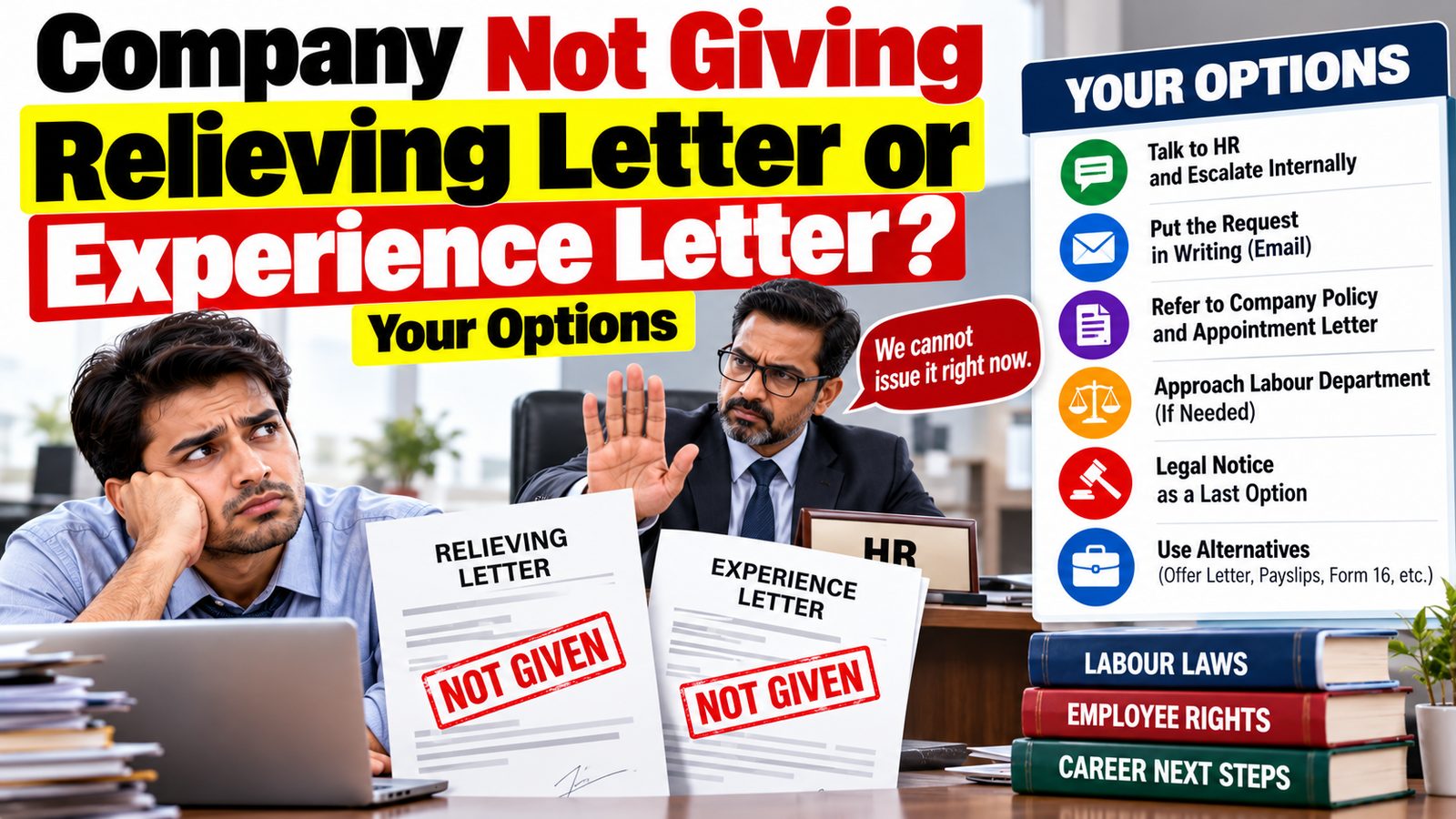
This is one of the most common and stressful problems Indian job switchers face, and good guidance on it is hard to find. The good news: you are not powerless. In most cases a firm, well-documented request resolves it; if not, there are legal routes; and even without the letter, you can usually prove your employment in other ways.
This guide explains the different exit documents, why companies withhold them, what the law actually says (including a 2026 High Court ruling and the new Labour Codes), and a step-by-step plan to get your letter — or work around it. It's general information, not legal advice; for a serious dispute, consult an employment lawyer.
Relieving letter, experience letter, service certificate: what's the difference?
| Document | What it says | Why it matters |
|---|---|---|
| Resignation acceptance | The company has accepted your resignation and confirms your last working day | Early proof that you resigned properly; useful if the relieving letter is delayed |
| Relieving letter | You have been formally released from your duties, usually after notice and handover | Most new employers ask for it at or before joining to confirm you're free to join |
| Experience letter | Your designation, dates of employment and sometimes role or conduct | Proof of experience for future jobs, visas and higher studies |
| Service certificate | A formal certificate of service — the document certain labour laws actually require employers to issue | Your strongest legal footing, as explained below |
Many companies combine the relieving and experience letters into one document. Others issue them separately after the full-and-final (F&F) settlement.
Why companies withhold letters
Knowing the reason tells you which fix will work.
Reasons employers usually treat as valid
- Notice period not served or not bought out. The most common reason. Employers often delay or deny the letter when you leave early without settling notice pay (Lawspicious).
- Company property not returned — laptop, ID card, data.
- Pending dues or recoveries — joining bonus clawback, training bond, salary advance.
- Incomplete handover or exit clearance.
- Ongoing misconduct investigation.
Reasons that are not legitimate
- Pressure to make you stay or withdraw your resignation.
- Retaliation for a complaint or dispute.
- Simple HR delay or disorganisation.
- The company has shut down or is in trouble.
Legal guides note that employers can withhold a relieving letter only on lawful grounds such as unserved notice, unreturned property or unsettled dues — and that even then, the better practice is to recover the shortfall through settlement and still issue documents. Refusal as punishment or pressure exposes the employer to complaints before labour authorities (Captain Legal).
What the law says
- There's no single "relieving letter law" — but service certificates are required in many cases. No central statute requires private employers to issue a relieving letter as such. However, several state Shops and Establishments Acts require employers to give a service or employment certificate on separation — for example, Maharashtra's 2017 Act requires a service certificate on termination, and Karnataka's Act has similar provisions (Hyring). Standing orders for industrial establishments have long entitled covered workers to a service certificate.
- The new Labour Codes strengthen this for covered workers. The four Labour Codes came into force on 21 November 2025, and the 2026 Model Standing Orders create a specific ten-day service-certificate right for covered workers. This shouldn't be overstated into an identical national relieving-letter rule for every senior or managerial employee (Fastrack Legal). The Code on Wages also requires final wages to be paid within two working days of separation (Captain Legal).
- A 2026 Bombay High Court ruling adds nuance. In Bharat Aviation, decided in May 2026, the Bombay High Court held that a relieving letter is not an unconditional right where an employee's resignation itself breached their agreement. The court said the employee is free to take another job, but can't insist the employer facilitate it with a relieving letter or a certificate of excellent service. Commentators stress that the law still mandates a service certificate, and that as a general rule a relieving letter or service certificate must still be issued (Legal500).
- Courts protect the right to livelihood. Courts have linked access to employment records with the right to livelihood under Article 21, and have held that an employer should still issue a service certificate even where it considers the employee's service unsatisfactory — while recording that in the certificate (Legal500).
What this means in practice: if you left properly — served or bought out notice, returned property, cleared dues — you're on strong ground. If you broke your contract, your employer may legally hold back the relieving letter, but you can still usually insist on a basic service or experience certificate that states your dates and designation.
What to do first: a step-by-step plan
Most cases are resolved at these stages. Keep everything in writing.
Step 1: Find out the exact reason. Email HR asking what's pending. Often it's a missing clearance signature, an unreturned asset or an F&F calculation.
Step 2: Close every open item. Return company property and get a written acknowledgement. Complete the handover and exit clearance. If you didn't serve full notice, offer to settle the notice shortfall — often by adjusting it against your final salary or leave encashment.
Step 3: Send a formal written request. Email HR, copying your former manager, with a clear subject line such as "Request for relieving and experience letter — [Name, Employee ID]". State your last working day, confirm that clearance is complete, and ask for the documents by a specific date (for example, within seven days).
Sample: "I resigned on [date] and my last working day was [date]. I have completed my handover and returned all company assets (acknowledgement attached). I request you to issue my relieving letter and experience letter by [date], as my new employer requires them for onboarding."
Step 4: Escalate internally. If HR doesn't respond, write to the HR head, your skip-level manager or the company's grievance or ethics channel. Mention that the delay is affecting your new employment.
Step 5: Talk to your new employer. Be transparent early. Many employers will accept a resignation acceptance email plus other proof (see below) and let you join, with the relieving letter to follow.
If that doesn't work: escalation options
| Option | What it involves | When to use it |
|---|---|---|
| Legal notice | A lawyer sends a formal notice to the company and its directors, citing the applicable Shops and Establishments Act or standing orders and your right to a service certificate, with a deadline | After internal requests fail; often enough on its own, because companies don't want a labour dispute |
| Labour department complaint | File a complaint with the labour commissioner or inspector (Shops and Establishments division) in the state where you worked | When your state's law requires a service certificate and the employer still refuses (Jurigram) |
| Civil suit for a mandatory injunction | A court can order the company to issue the documents under the Specific Relief Act (AMA Legal) | Serious or high-stakes cases; slower and costlier |
| Writ petition | A petition to the High Court | Mainly where the employer is a government or public body |
Things to know before escalating
- Escalation works best when you've left properly. If you breached your notice or bond terms, settle that first; otherwise the employer may counter-claim, and the 2026 Bombay High Court ruling may work against you.
- Ask for at least a service or experience certificate stating your dates and designation, even if the relieving letter is disputed.
- Keep all evidence: resignation and acceptance emails, clearance forms, asset return receipts, salary slips and your written requests.
- Get proper legal advice for anything beyond a legal notice; procedures and laws vary by state.
Proving your employment without the letter
While you pursue the letter, you can usually satisfy your new employer and background verification with alternative evidence. Present it upfront, organised in one folder.
| What you need to prove | Alternative documents |
|---|---|
| You worked there | Offer and appointment letters, ID card copy, official email records |
| Your dates of employment | UAN / EPFO service history and passbook showing PF contributions month by month, first and last payslips |
| Your salary | Payslips, Form 16, bank statements showing salary credits |
| You resigned properly | Resignation email and the company's acceptance, exit clearance or F&F statement |
| Your role and performance | Appraisal letters, promotion letters, a reference from your former manager |
The UAN service history is especially powerful, because it's an official record showing each employer and the months you were paid — BGV agencies increasingly rely on it anyway.
If the company has shut down, tell your new employer and BGV agency upfront. Provide the documents above plus any evidence of closure, such as news reports or the company's status on the Ministry of Corporate Affairs portal, and a reference from a former senior colleague.
Ask your new employer for a written undertaking option. Some employers let you sign a declaration and submit the relieving letter within 30–90 days of joining.
Prevent the problem next time
- Resign by email so you have a dated record, and get written acceptance with your last working day
- Read your contract's notice, bond and recovery clauses before accepting a new offer
- Negotiate early release or a notice buyout in writing
- Return all assets and get signed acknowledgements
- Download your payslips, Form 16 and appraisal letters before your last day, since system access often ends immediately
- Check your UAN service history and make sure your exit date is updated
- Ask HR on your last day when to expect the relieving letter and F&F
- Tell your new employer early if there's any risk of delay
The bottom line: a withheld relieving letter feels like a trap, but it rarely is. Close every open item, put your request in writing, escalate firmly, and use alternative proof so your new job isn't held hostage. If your employer refuses without a valid reason, the law — especially on service certificates — is on your side.