Do Indian Companies Use AI to Screen Resumes? How ATS Works on Naukri and LinkedIn
The short answer: yes — and increasingly so. Most large Indian employers now use some form of software to sort, search or rank resumes before a person reads them, and a growing number use AI to do it. But the popular idea that a robot silently rejects 75% of resumes for missing a keyword is mostly a myth. In practice, technology decides which resumes a recruiter sees first, and a human usually makes the shortlist.
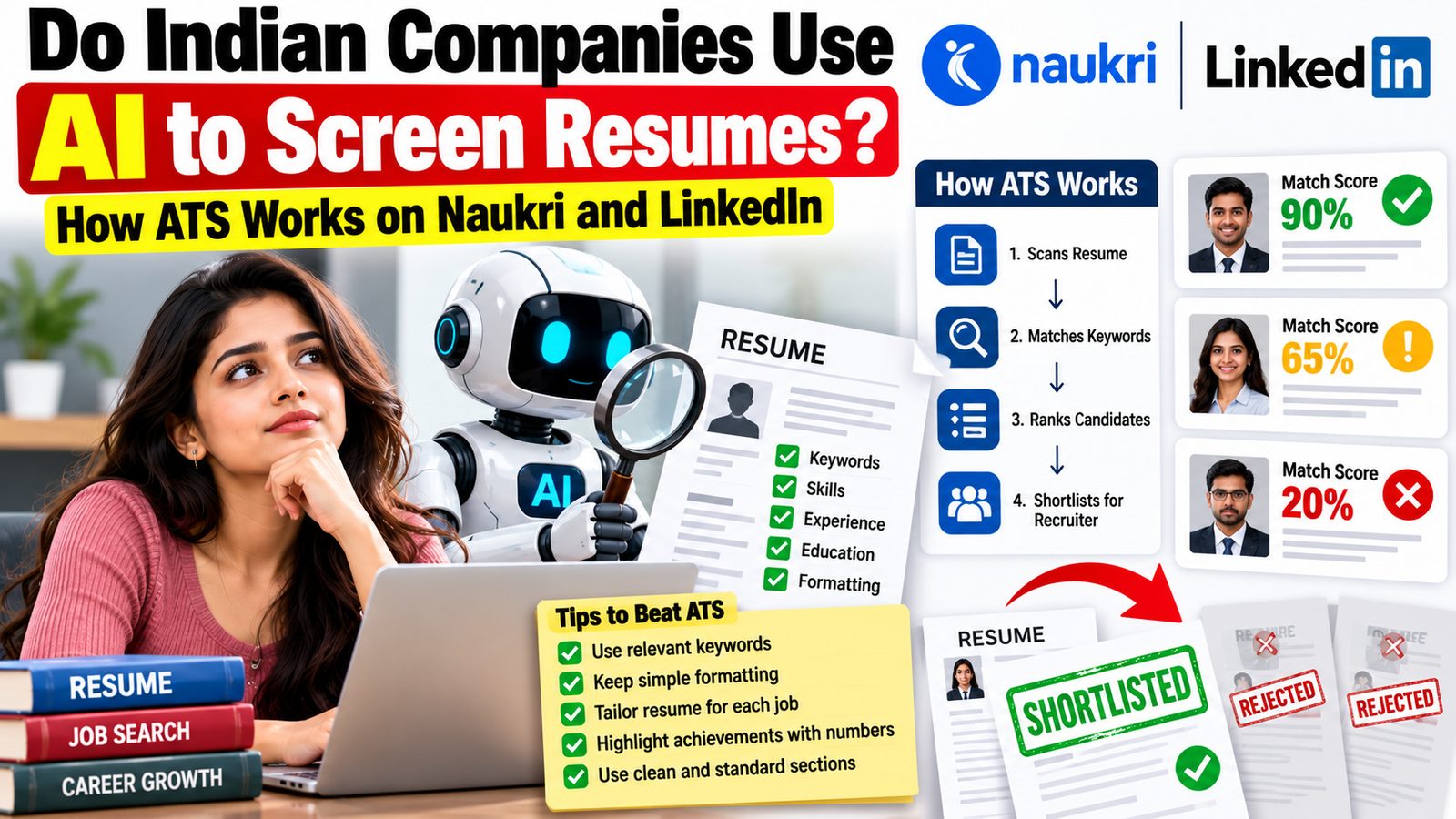
If you're applying through Naukri or LinkedIn, there's a second layer most candidates don't realise: recruiters often don't wait for applications at all. They search these platforms' databases with keywords and filters, so whether you appear in their results depends on how your profile is written.
This guide explains how AI and applicant tracking systems (ATS) are used in Indian hiring, how Naukri and LinkedIn actually surface candidates to recruiters, and exactly how to write a resume and profile that works for both software and people.
How widely Indian companies use AI in hiring
The most recent India-specific data comes from Deloitte India's Campus Workforce Trends 2026: 86% of organisations say AI or agentic AI is transforming their recruitment, and 72% use AI for resume screening, the most common use case (Brilliant Resumes).
But adoption is uneven. Globally, Indeed's Hiring Lab found AI adoption concentrated among the largest employers, with most AI-related job postings coming from a small share of companies (Employer Branding News). In India the pattern is similar:
| Employer type | What you'll typically face |
|---|---|
| Large IT services, GCCs, MNCs, big banks | A full ATS (such as Workday, SAP SuccessFactors, Oracle, Darwinbox or iCIMS), often with AI matching, online tests and sometimes AI video or voice screening |
| High-volume roles (BPO, retail, delivery, campus hiring) | Heavy automation: AI chatbots, voice screening and automated tests to handle thousands of applicants |
| Mid-size companies and startups | Lighter ATS tools (such as Zoho Recruit, Keka or Freshteam), plus recruiters searching Naukri and LinkedIn directly |
| Small businesses | Mostly manual: a recruiter or owner reads resumes from email, WhatsApp or job portals |
What does AI actually do? Most commonly, it parses your resume into structured fields, matches it against the job description, ranks applicants, and handles scheduling and messaging. Final hiring decisions still largely rest with people.
How a company ATS really works (and the 75% myth)
An applicant tracking system is the software a company uses to post jobs, collect applications and manage candidates. When you apply on a company's careers page, here's what typically happens:
- Knockout questions. You answer screening questions — notice period, location, willingness to relocate, minimum qualification, years of experience. These are the filters most likely to reject you automatically.
- Parsing. The ATS extracts your name, contact details, work history, education and skills from your resume into structured fields.
- Matching and ranking. Many systems, especially newer AI-enabled ones, compare your profile with the job description and give a match score or ranking.
- Recruiter search and review. A recruiter filters and searches applicants (for example, "Python AND Django, 3–5 years, Pune"), sorts by score or date, and reads the resumes that surface.
- Human decision. The recruiter or hiring manager shortlists, rejects or moves candidates forward.
The "75% of resumes are rejected by ATS" claim is a myth. It traces back to a 2012 sales pitch by Preptel, a resume-optimisation company that later shut down, and was never backed by a published study (The Interview Guys). When Enhancv interviewed 25 US recruiters, 92% said their ATS doesn't automatically reject resumes based on formatting, design or content — but all of them used knockout questions for eligibility factors like work authorisation, licences or location (WBOC / Enhancv). That study was small and US-based, and there's no comparable India study, but most of the ATS platforms used by Indian employers are the same global products and work the same way.
So why don't you hear back? Usually not because a robot binned you, but because:
- You failed a knockout question (notice period too long, wrong location, missing qualification).
- Your resume didn't contain the keywords the recruiter searched for, so it never surfaced — buried, not rejected.
- Hundreds of others applied, and the recruiter stopped after finding enough good matches.
- Your resume was read and didn't convince a human in the few seconds they spent on it.
How Naukri decides which recruiters see you
On Naukri there are two routes to a recruiter:
- You apply to a job. Your application lands in the employer's Naukri dashboard or ATS, where it's filtered and ranked against the job.
- The recruiter finds you. This is the bigger opportunity. Recruiters search Naukri's paid resume database, Resdex, using keywords and filters, then contact people directly — often people who never applied.
What recruiters filter on in Resdex. Recruiters typically build a search from keywords (skills, titles, tools) and filters such as location, experience, CTC, notice period and education, then work through results ranked by relevance and freshness (GoodSpace). A filter like "active in the last 15 days" is common (Profylo), so an inactive profile can disappear from searches even if it's strong.
Where AI comes in. Naukri's own product updates describe several AI features in Resdex Enterprise (Naukri):
- An "AI Relevance" sort that learns each recruiter's selection patterns and personalises how candidates are ranked.
- AI profile tags such as "Hidden Gem" (strong profiles with little recruiter attention so far), "Trending" and "Actively Applying".
- AI-generated CV highlights that summarise a candidate at a glance.
What this means for you: keywords still decide whether you appear in a search; activity and freshness affect whether you're near the top; and AI increasingly decides how your profile is summarised and ranked for each recruiter. Naukri doesn't publish its exact ranking formula, so treat claims about precise "scores" or hacks with caution. One profile-tool company even notes that trivial edits no longer boost freshness as much as they once did (Profylo).
How LinkedIn's AI finds and ranks you
LinkedIn has moved further into AI than any other platform Indian job seekers use. Recruiters on its paid Recruiter product can now describe a role in plain English, and LinkedIn turns that into filters and a candidate list. Its AI agent, Hiring Assistant, runs many searches across LinkedIn, surfaces qualified candidates and reviews thousands of applicants against the recruiter's criteria (LinkedIn).
What's different from simple keyword search
- Skills inference. LinkedIn's search understands related terms and infers skills from context — for example, a profile describing work on recommendation engines can be recognised as having machine-learning skills even if that phrase isn't listed (Noon).
- Relevance labels. Advanced AI-assisted search can show recruiters high, medium or low relevance labels for candidates (HeroHunt).
- Learning from the recruiter's history. The latest Hiring Assistant uses memory of what a recruiter has hired for before — location, industry, seniority — and shows signals of how receptive a candidate might be, based on platform engagement, Open to Work details and InMail responsiveness (Social Media Today).
- Open to Work. Recruiters with the full Recruiter product can see candidates who've privately signalled they're open to roles (HeroHunt).
- Trust signals. LinkedIn is adding verifications to help recruiters identify legitimate profiles (Social Media Today).
What this means for you: on LinkedIn, a clear description of what you actually did matters more than stuffing exact keywords, because the AI reads context. Being active, responsive and visibly open to work also matters, because the AI factors in how likely you are to reply. Hiring Assistant only surfaces people with active LinkedIn profiles (Pin), so an empty or outdated profile is effectively invisible.
How to write a resume that works for AI and humans
The goal isn't to "beat" software. It's to make it easy for any system — old keyword search or new AI — to understand you, and then to convince the human who reads it.
Make it easy to parse
- Use a simple, single-column layout with standard headings: Summary, Experience, Education, Skills, Projects, Certifications.
- Submit a text-based PDF or Word file, not a scanned image or photo of a resume.
- Keep important information out of headers, footers, text boxes and images, which some parsers skip.
- Write dates consistently (for example, "Mar 2023 – Present") and use the company's real name.
Use the right words
- Mirror the exact skill and job-title terms from the job description — if the post says "Power BI", don't only write "BI dashboards".
- Include both the acronym and full form once: "Search Engine Optimisation (SEO)".
- Add a focused skills section, but also mention key skills inside your experience bullets so the context is clear.
- Never hide white-text keywords or copy the whole job description — recruiters see it, and it destroys trust.
Then win the human
- Lead each bullet with a result: "Reduced invoice processing time by 40% by automating reconciliation in Excel and Power Automate."
- Keep it to one or two pages; recruiters spend very little time on each resume.
- Tailor your summary and top bullets for each important application.
Answer screening questions carefully. Questions about notice period, location, relocation and years of experience are the most common automatic filters. Answer honestly but precisely — for example, mention if your notice period is negotiable or can be bought out.
Optimise your Naukri and LinkedIn profiles
| Naukri | ||
|---|---|---|
| Headline | Role + key skills + experience, e.g. "Data Analyst · SQL, Power BI, Python · 3 Years" | Role + specialisation + proof, e.g. "Data Analyst at XYZ — SQL, Power BI — cut reporting time 40%" |
| Skills | Fill the Key Skills field with the exact terms recruiters search | Add your top skills, pin the most important, and earn endorsements or assessments |
| Experience | Complete every role with dates, designation and 3–5 result-focused lines | Describe what you did in plain language with results; the AI infers skills from context |
| Filters recruiters use | Keep current location, preferred locations, CTC, expected CTC and notice period accurate | Set location, job titles and work preferences in Open to Work (private recruiter-only option available) |
| Activity | Log in and update meaningfully during an active search; real updates matter more than cosmetic edits | Stay active, respond to InMails and keep your profile current |
| Resume upload | Upload a clean, text-based, tailored resume | Add a featured section with projects, portfolios or certificates |
| Trust | Verify email and mobile; complete your profile | Add verification badges where available |
One profile, one story. Keep job titles, dates and companies identical across your resume, Naukri and LinkedIn — recruiters notice mismatches, and so does background verification later.
Be careful with paid boosts. Naukri and LinkedIn both sell visibility features. They can increase views, but they don't fix a weak or poorly matched profile. Get the basics right first.
Quick checklist
- Simple, single-column, text-based resume with standard headings
- Exact skill and title keywords from the job description, used honestly and in context
- Result-focused bullets with numbers
- Screening questions (notice period, location, experience) answered accurately
- Naukri headline, key skills, CTC, location and notice period complete and current
- LinkedIn headline, experience descriptions and Open to Work preferences set
- Same titles and dates everywhere
- Profiles updated meaningfully during your search
The bottom line: Indian companies increasingly use AI to search, sort and summarise candidates, but AI mostly decides who gets seen first, not who gets hired. Write for clarity, use the words recruiters search for, keep your profiles active, and make every line convincing to the human who reads it. ResumeMinter's ATS-friendly templates give you a clean, parseable structure to start with — free.