Government Jobs for Persons With Disabilities (PwBD): Posts, Relaxations and Scribe Rules
For persons with disabilities, government jobs offer something the private sector often doesn't: a legal guarantee of reserved seats, extra years to compete, exam support such as scribes and extra time, and workplace protections backed by law. Yet many eligible candidates either don't know these rights exist or lose out because of certificate and application mistakes.
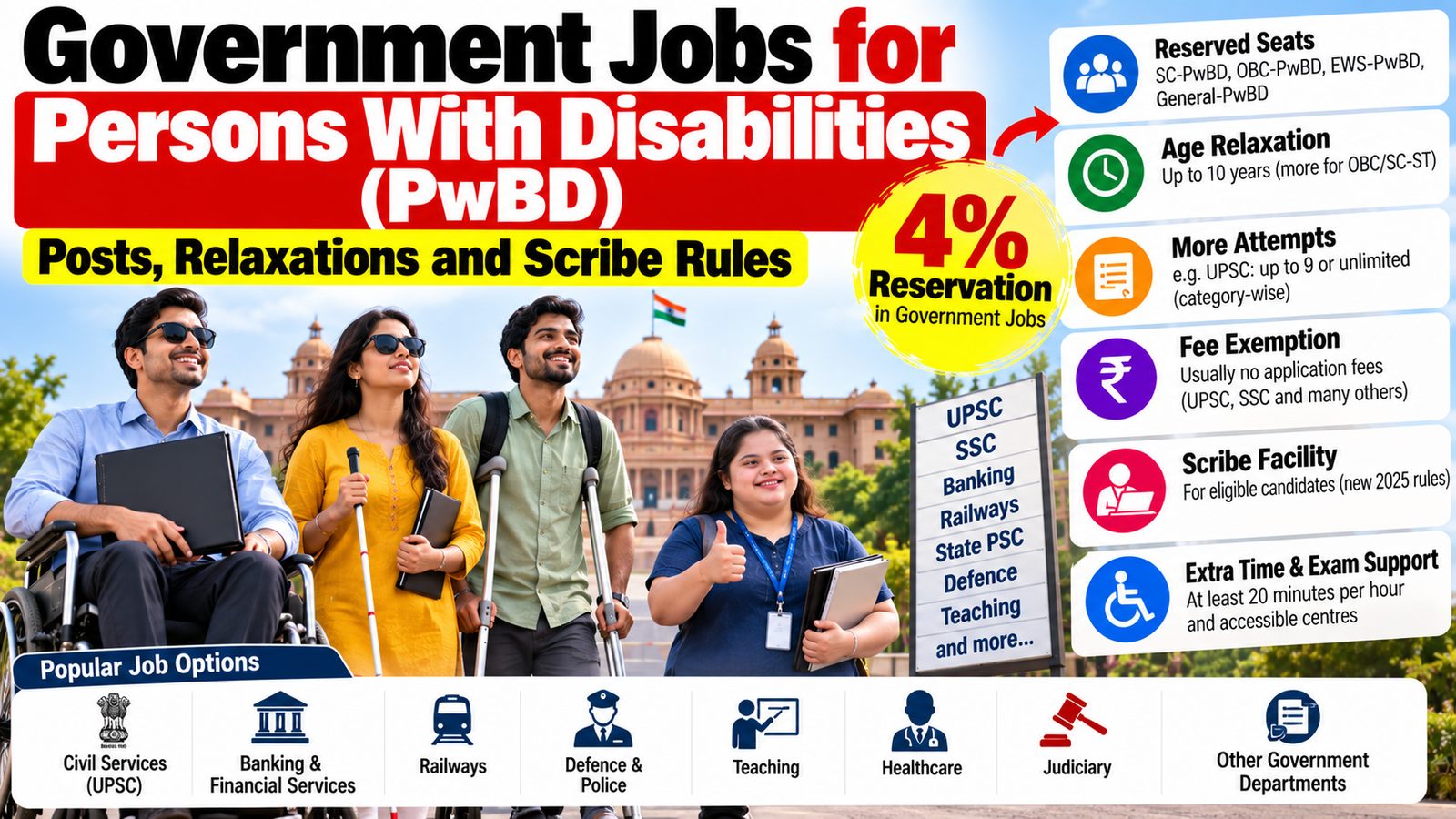
This guide explains, in plain language, who qualifies as a Person with Benchmark Disability (PwBD), how the 4% job reservation works, the age, attempt and fee relaxations you get, the latest scribe and compensatory-time rules (which changed significantly in 2025), the best exams and posts, and how to apply without problems. Rules vary between exams and get updated, so always check the latest notification.
Who qualifies, and how the 4% reservation works
The law. The Rights of Persons with Disabilities (RPwD) Act, 2016 replaced the older 1995 Act and lists 21 specified disabilities (BharatNotes).
Benchmark disability. To get reservation and most relaxations, you need a "benchmark disability": at least 40% of a specified disability, certified by a notified medical authority (BharatNotes).
The 4% reservation. Under Section 34 of the Act, 4% of vacancies in identified posts are reserved for PwBD candidates (BharatNotes):
| Category | Disabilities covered | Share |
|---|---|---|
| (a) | Blindness and low vision | 1% |
| (b) | Deaf and hard of hearing | 1% |
| (c) | Locomotor disability, including cerebral palsy, leprosy cured, dwarfism, acid attack victims and muscular dystrophy | 1% |
| (d) & (e) | Autism, intellectual disability, specific learning disability and mental illness; multiple disabilities from the above | 1% combined |
Horizontal reservation. PwBD reservation cuts across other categories, so you can be SC-PwBD, OBC-PwBD, EWS-PwBD or General-PwBD and benefit from both (BharatNotes).
Identified posts. Reservation applies only to posts the government has identified as suitable for each disability category. Each notification lists which categories are eligible for each post, so check this before applying.
Relaxations: age, attempts and fees
Age. In central government direct recruitment, PwBD candidates get 10 extra years over the upper age limit, which adds to category relaxations: 13 years for OBC-PwBD and 15 years for SC/ST-PwBD (Advocate Gandhi).
UPSC Civil Services example
| Category | Maximum age | Attempts |
|---|---|---|
| General / EWS (non-PwBD) | 32 | 6 |
| General / EWS PwBD | 42 | 9 |
| OBC PwBD | 45 | 9 |
| SC / ST PwBD | 47 | Unlimited |
Source: Anantam IAS. Other exams apply the same 10-year principle to their own age limits — for example, a General candidate eligible for SSC CGL up to 32 would be eligible up to 42 as PwBD, subject to the notification.
Fees. PwBD candidates are generally exempt from application fees for UPSC and SSC exams, and many other recruiters give exemptions or concessions.
Other relaxations that vary by exam:
- Relaxed qualifying standards in some exams when enough PwBD candidates don't qualify at general standards.
- Exemption from certain physical tests, depending on the post.
- Choice of accessible exam centres (ground-floor rooms, ramps) when requested.
Important: relaxations apply only with a valid disability certificate in the prescribed format. Candidates with less than 40% disability don't get reservation or age relaxation, though they may get scribe or extra time if they have a certified writing difficulty (see next section).
Scribe and compensatory time: the current rules
Compensatory (extra) time. Eligible candidates get at least 20 minutes for every hour of the exam, whether or not they use a scribe or assistive technology (Careers360). For exams under an hour, time is given pro rata. For example, a 2-hour UPSC Prelims paper becomes 2 hours 40 minutes (BharatNotes).
Who gets a scribe. Candidates with blindness, locomotor disability affecting both arms, or cerebral palsy usually get scribe facilities directly. Other benchmark-disability candidates can get one with a certificate confirming their writing limitation. Since DEPwD's 10 August 2022 guidelines, candidates with less than 40% disability who have difficulty writing can also get a scribe and/or extra time with the prescribed certificate (NIRTH guidelines).
The big 2025 change: "own scribe" is being phased out. In line with revised DEPwD guidelines, SSC discontinued its long-standing own-scribe facility and now allows only Commission-provided scribes, applying this to all its exams (Careers360). Under the revised framework:
- A scribe for central recruitment exams such as SSC CGL, UPSC and NDA should have an academic qualification two to three years below the minimum required for the candidate.
- You can meet your assigned scribe for a 20-minute interaction session before the exam, and in exceptional cases request a change — for example, because of a language barrier.
- Candidates are encouraged to use assistive technology wherever feasible (Careers360).
Other recruiters may still differ. Some banking and regulator notifications from late 2025 still describe candidates arranging their own scribe (IBPS notice). Read your specific notification's scribe annexure carefully.
How to request a scribe or extra time
- Select the scribe and/or compensatory time options in the online application — you usually can't add them later.
- Upload the required certificate, such as the writing-limitation certificate in the prescribed appendix format, if your category needs one.
- Carry the original certificates on exam day and at document verification.
Best exams and posts for PwBD candidates
Almost every major government exam reserves seats for PwBD candidates in identified posts. These are among the strongest options:
| Exam / recruiter | Popular posts | Why it's a good fit |
|---|---|---|
| UPSC Civil Services | IAS, IRS, IRTS, other Group A services | 4% reservation across services, up to 9 or unlimited attempts, office-based roles in many services |
| SSC CGL, CHSL, MTS | Income Tax Inspector, Assistant Section Officer, Auditor, clerical posts | Large numbers of desk-based posts identified for most disability categories |
| Bank PO and Clerk (IBPS, SBI) | Probationary Officer, Clerk | Branches everywhere; many roles identified for PwBD candidates |
| RBI, SEBI, NABARD | Grade A/B officers | High pay, office-based roles; check each notification's identified categories |
| Railways (RRB) | NTPC clerical and accounts posts | Large vacancy numbers; some technical and field posts may not be identified for certain disabilities |
| Teaching (KVS, NVS, states) | Teachers, librarians | Reservation applies in central and most state recruitments |
| State PSCs | State civil services, clerical posts | State reservations of 4% or more and often higher age limits |
| PSUs | Officers and staff | PwBD reservation in identified posts at central PSUs |
Posts that are often not identified for some or all disability categories include combat and field roles in police, defence and CAPFs, and physically demanding operational posts. Check the "suitable for" list against your disability category in every notification.
Tip: if a post you want isn't open to your category, look for similar desk-based posts in the same exam — for example, ministerial or accounts posts instead of field inspector roles.
Your rights once you're in the job
The RPwD Act protects you after selection too, not just during recruitment.
- No discrimination. Government establishments must not discriminate against persons with disabilities in employment, and must provide reasonable accommodation and a barrier-free environment.
- Assistive devices and accessible workplaces. You can request accessible workstations, screen readers, ramps, accessible toilets and other aids needed to do your job.
- Protection if you acquire a disability. An employee who acquires a disability during service can't be dismissed or demoted for it; if they can't continue in the same post, they're to be shifted to another post with the same pay and benefits.
- Posting and transfer considerations. Central government guidelines generally favour postings near home for employees with disabilities and exemptions from routine rotational transfers, subject to administrative needs.
- Promotion reservation. Reservation for PwBD employees also applies in promotions in many cadres, under government guidelines.
- Grievance redress. Government establishments are required to appoint a Grievance Redressal Officer; you can also approach the Chief Commissioner or your State Commissioner for Persons with Disabilities.
Allowances such as a higher transport allowance for certain disabilities also apply to central government employees; check the latest Department of Expenditure rules for your case.
Applying without problems
Get your documents right first
- Disability certificate from a notified medical authority, showing the disability type and percentage. Many recruiters ask for it in a specific format, so check the notification's appendix.
- UDID card (Unique Disability ID) — apply at swavlambancard.gov.in. It's increasingly accepted as proof and makes verification easier.
- Writing-limitation certificate in the prescribed format, if you need a scribe or extra time and your category requires it.
- Category certificate (SC, ST, OBC-NCL, EWS) if you're also claiming that reservation.
Common mistakes that cost candidates
| Mistake | Fix |
|---|---|
| Disability type on certificate doesn't match the category selected | Select the category exactly as stated on your certificate |
| Old or wrong-format certificate | Get a current certificate in the format the notification asks for |
| Scribe or extra time not requested in the form | Tick these options at application stage; they usually can't be added later |
| Applying for a post not identified for your disability | Check the post-wise suitability list before applying |
| Disability below 40% claimed as PwBD | Below 40% doesn't qualify for reservation; claim only scribe or extra time if eligible |
The bottom line: the law gives PwBD candidates real advantages — reserved seats, up to 15 extra years, more attempts, fee waivers and exam support. The candidates who benefit most are those who get their certificates in order early, read each notification carefully, and apply on time. When your resume is ready for private-sector options too, build it free on ResumeMinter.