How to Explain a Career Gap on Your Resume and in Interviews
A gap on your resume can feel like a red mark you need to hide. It isn't.
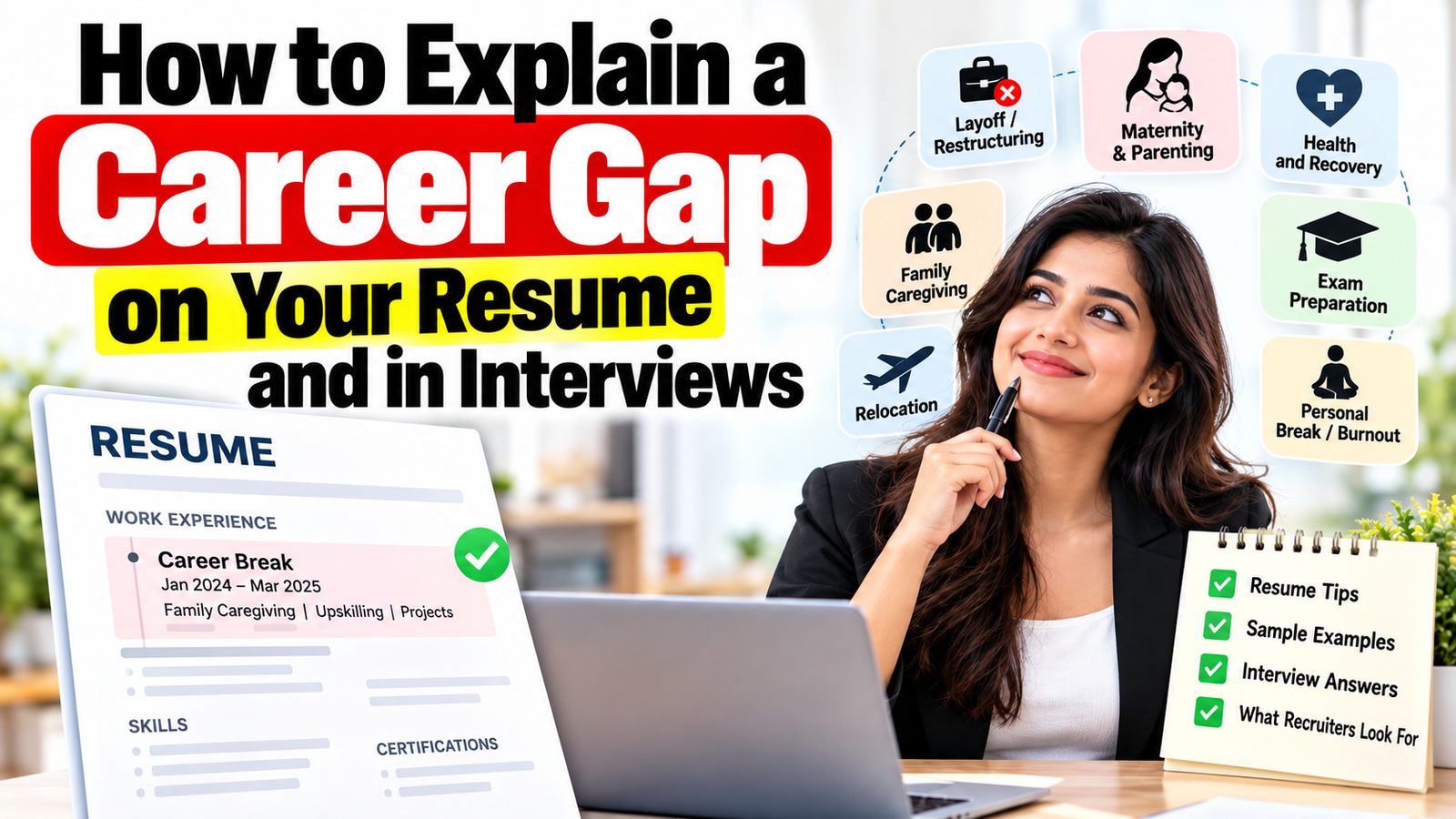
Career breaks are far more common than most people think: in a LinkedIn survey of nearly 23,000 workers, 62% said they had taken a career break at some point, rising to 64% among women (Allwork.Space). Layoffs, illness, caregiving, maternity, exam preparation, further study, relocation and burnout are all part of normal working lives.
What hurts candidates is rarely the gap itself. It's an unexplained gap, a vague or defensive answer, or a resume that tries to hide the dates. The good news is that a career gap is one of the most fixable problems in a job search. With an honest, confident explanation and evidence that you're ready to work, most recruiters will move on quickly.
This guide shows you exactly how to present a gap on your resume, LinkedIn and cover letter, how to answer the question in interviews, and how to handle specific situations like layoffs, health breaks, maternity and government exam preparation.
What recruiters actually worry about
Attitudes have softened, but stigma hasn't disappeared. In the same LinkedIn research, 46% of hiring managers said candidates with career breaks are an untapped talent pool — yet about one in five said they would reject an applicant with a job gap outright (WorkLife). Your goal is to reassure the majority quickly.
When a recruiter sees a gap, they're usually asking four hidden questions:
| Hidden question | What they fear | How to reassure them |
|---|---|---|
| Why did it happen? | You were fired for performance or misconduct | Give a clear, honest one-line reason |
| Are your skills current? | You've fallen behind on tools and trends | Show courses, certifications, projects or freelance work |
| Are you ready now? | The issue that caused the break isn't resolved | State that the situation is behind you and you're fully available |
| Will you stay? | You'll leave again soon | Explain why this role fits your long-term plan |
Hiring managers also want candidates to address the break head-on. 52% said candidates should proactively bring it up in interviews and explain what they learned, and 49% said the biggest mistake is downplaying a gap instead of presenting it as an asset (Allwork.Space, WorkLife).
How to show a career gap on your resume
Rule 1: Don't hide it, label it. Background checks in India routinely verify employment dates, so fake dates or stretched tenures can cost you the offer. A short, honest label in the timeline is far safer and looks confident.
Rule 2: Match the format to the gap length.
| Gap length | What to do |
|---|---|
| Under 6 months | Usually no explanation needed. Use years only (e.g. 2023–2025) if your format allows, and be ready to explain in interviews. |
| 6 months to 2 years | Add a one-line "Career Break" entry in your experience section with the reason and what you did. |
| Over 2 years | Use a career break entry plus a strong "Recent Learning and Projects" section. Consider a combination (skills-first) resume format. |
Rule 3: Write it like a job entry. Keep it short, factual and forward-looking. Here are examples you can adapt:
- Career Break — Family Caregiving | Jan 2024 – Mar 2025 Provided full-time care for a family member. Completed Google Data Analytics Certificate and built two dashboard projects in Power BI.
- Career Break — Maternity and Parenting | Jun 2023 – Aug 2025 Full-time parenting. Refreshed skills through an online course in digital marketing and managed social media for a local NGO.
- Career Transition | Apr 2025 – Present Role affected by company-wide restructuring. Completed AWS Cloud Practitioner certification and freelance cloud migration project for a small business.
- Competitive Exam Preparation | Jul 2023 – Jun 2025 Prepared for UPSC Civil Services; cleared Prelims (2024). Strengthened research, analysis and writing on economics and public policy.
- Health and Recovery | Feb 2024 – Nov 2024 Took time off to address a health matter, now fully resolved. Completed advanced Excel and SQL courses during recovery.
Rule 4: Put the strongest proof nearby. Add a section such as "Recent Certifications" or "Projects" so the recruiter's eye moves from the gap straight to evidence that your skills are current.
You don't need to share private medical or family details. A brief, neutral reason is enough.
On LinkedIn and in your cover letter
LinkedIn. LinkedIn lets you add a "Career Break" directly in your Experience section, with types such as full-time parenting, caregiving, bereavement, gap year, career transition and layoff (YourStory). Use it, add a one-line description of what you did, and list any courses under Licences and Certifications. Your resume and LinkedIn dates should match exactly.
Cover letter. Address the gap in one or two sentences, then move straight to why you fit the role. Don't apologise, and don't let it take over the letter.
"After two years of full-time caregiving for my father, I am returning to work fully available and refreshed. During this time I completed a certification in financial modelling, and I'm excited to bring my six years of audit experience to your team."
"My previous role was part of a company-wide restructuring in early 2025. Since then I've used the time to earn my Google Cloud certification and complete two freelance projects, and I'm now looking for a long-term role where I can apply these skills."
How to answer "Can you explain this gap?" in an interview
Use a simple three-part answer that takes 30–60 seconds: Reason → Growth → Readiness.
- Reason (one or two sentences). State why you took the break, honestly and without over-explaining.
- Growth (one or two sentences). Share what you did or learned: a course, project, freelance work, volunteering or a skill strengthened by life experience.
- Readiness (one sentence). Confirm the situation is behind you and connect back to this role.
Then stop talking. Silence after a good answer is fine; over-explaining sounds defensive.
Sample answers
Layoff:
"My role was eliminated in a company-wide restructuring in March, along with about 200 others. I used the time to complete a product management certification and helped a friend's startup with user research. I'm now looking for a stable, long-term role, and this position is a strong fit for my experience in SaaS products."
Caregiving:
"I took 18 months off to care for my mother after her surgery. She has recovered well and has support in place now. While caregiving, I kept my skills current with an advanced Excel and Power BI course. I'm fully available and keen to return to financial analysis."
Maternity and parenting:
"I took two years off after the birth of my son. He's now in daycare and we have strong family support. In the last six months I completed a digital marketing certification and ran campaigns for a local business, so I'm ready to return to marketing full-time."
Health:
"I took some time off to deal with a health issue, which is now fully resolved. I used the recovery period to learn Python basics, and I'm energised to get back to work."
You are not obliged to share medical details.
Burnout or personal reset:
"After five intense years in consulting, I took a planned six-month break to reset and decide what I wanted next. I spent that time on a data analytics course and some travel. It confirmed that I want to move into analytics, which is why this role appeals to me."
Special cases common in India
Government exam preparation (UPSC, SSC, banking, state PSC). This is one of the most common gaps in India, and many candidates worry it looks like "wasted years." Present it as structured, intensive work: you followed a disciplined study schedule, mastered large volumes of material, and built research, writing and analytical skills. Mention milestones honestly ("cleared Prelims twice"). In interviews, show that your move to the private sector is a clear, final decision: "I gave it my full effort for two years. I've now decided to build my career in policy research, where I can apply what I learned."
Layoff. With IT and tech layoffs widespread, recruiters understand that many good people lost jobs through no fault of their own. Say it was a restructuring or role elimination, mention how many people were affected if you know, and never criticise your former employer.
Fired or let go for performance. Don't lie, but don't over-share. Take responsibility briefly, show what you learned and changed, and focus on the future: "The role wasn't the right fit for my strengths. I learned a lot about [skill], and I've since [course or project], which is why I'm confident about this role."
Failed startup or business. Treat it as experience, not a gap. List it as a role ("Founder, XYZ | 2023–2025") with achievements — customers won, revenue, team built — and the lessons learned. Many employers value entrepreneurial experience.
Long gap (3+ years). Lead with a skills-first resume, earn a recent certification, and look for returnship programmes, contract roles or internships to rebuild a recent track record. Apply for roles a level below your last one if needed, then grow quickly.
Freshers with a gap after graduation. Show what you did: courses, internships, projects, freelance work or preparing for higher studies. A GitHub profile, portfolio or certificates make the gap far less noticeable.
Shrink the gap now: build recent proof
The best way to answer the gap question is to make it less relevant. Even four to eight weeks of focused activity gives you something current to talk about.
- Earn a recent certification. Short courses from Google, Microsoft, AWS, Coursera, NPTEL or industry bodies show your skills are up to date. Pick one directly linked to the roles you want.
- Do freelance, contract or volunteer work. A small project for a local business, NGO or friend's startup counts as real experience and gives you a reference.
- Build a portfolio. For tech, design, marketing or data roles, two or three strong projects on GitHub, Behance or a simple website speak louder than any explanation.
- Learn the AI tools in your field. Many roles now expect familiarity with AI assistants and tools; showing you've learned them during your break signals you're ahead, not behind.
- Reconnect with your network. Former managers and colleagues are the fastest route back. A referral often matters more than the gap.
Returnship programmes. Several large employers in India run programmes for professionals, especially women, returning after a break. Examples include Amazon's Rekindle and the Tata Group's Second Careers Inspiring Possibilities programme, as well as Accenture's Career Reboot for Women and Goldman Sachs' India returnship (SheWork), Axis Bank's Reconnect and Aditya Birla Fashion and Retail's Encore (Outlook Business). Eligibility and intake dates vary, so check each company's careers page.
Mistakes to avoid
| Mistake | Why it hurts | Do this instead |
|---|---|---|
| Faking dates or stretching tenures | Background verification will catch it and can cost you the offer | Show the gap honestly with a short label |
| Over-explaining or sharing private details | Sounds defensive and raises new worries | Keep it to one or two sentences |
| Apologising or sounding ashamed | Makes the recruiter doubt you too | State it calmly as a fact |
| Criticising a former employer | Looks unprofessional | Stay neutral: "the role was eliminated" |
| Saying "I did nothing" | Leaves the recruiter to imagine the worst | Mention anything you learned or did, even small |
| Inconsistent dates across resume, LinkedIn and forms | Looks dishonest | Use the same dates everywhere |
| Mentioning uncertainty ("I may go back to exam prep") | Signals you might leave | Show a clear, committed decision |
Your career gap checklist
- Add a short, honest "Career Break" entry to your resume with matching dates
- Add at least one recent certification, project or freelance assignment
- Add a Career Break to your LinkedIn profile with the same dates
- Write a one-to-two sentence gap line for your cover letter
- Prepare and practise a 30–60 second Reason → Growth → Readiness answer
- Check returnship programmes and reconnect with five former colleagues
The bottom line: a career gap is part of your story, not the end of it. Recruiters hire people who are honest, current and ready. Show all three, and the gap becomes a 30-second conversation instead of a deal-breaker.
Ready to put this into practice? Build a clean, ATS-friendly resume with a well-presented career break section on ResumeMinter, free.