New Labour Codes: What Changes in Your Salary Slip, PF and Take-Home Pay
If your salary slip looks different this year — a bigger PF deduction, a slightly smaller credit to your bank account, or a restructured CTC breakup — India's new Labour Codes are the most likely reason.
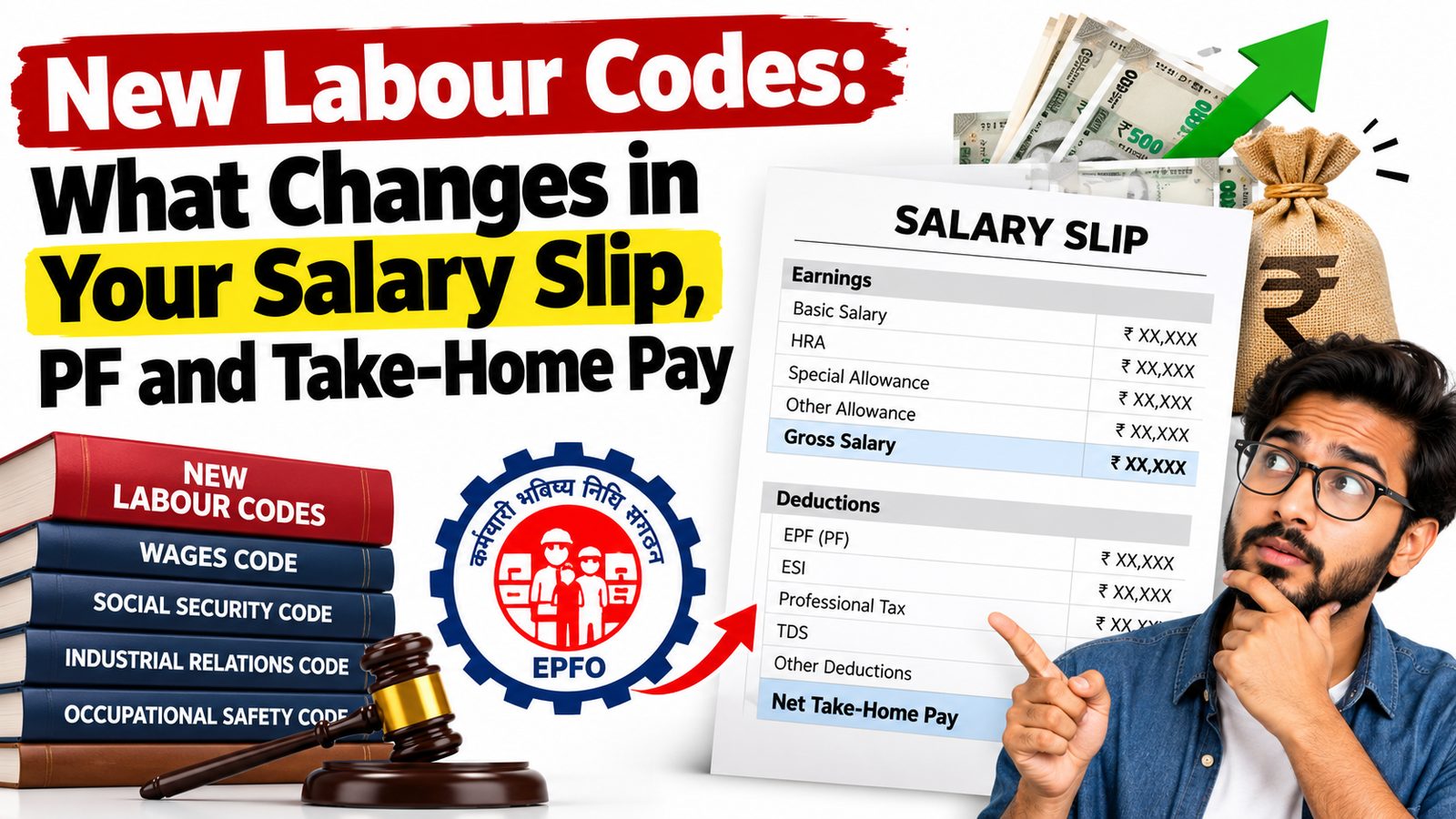
The four codes replaced 29 older labour laws and came into force on 21 November 2025 (Kredily). For salaried employees, the biggest change is a new, uniform definition of "wages" — often called the 50% wage rule — which changes how PF, gratuity and other benefits are calculated, and can lower monthly take-home pay while raising long-term savings.
This guide explains, in plain language, where implementation stands, how the 50% rule works, what it does to a real salary slip, who will and won't see a change in PF, the new rules on gratuity and final settlement, and what to check with your HR team.
Where implementation stands
There has been a lot of confusion about dates, so here's the timeline:
| Milestone | Date |
|---|---|
| Four Labour Codes and the new definition of wages in force | 21 November 2025 |
| Central Rules notified for all four codes | 8 May 2026 (Access Financial) |
| State rules | Arriving state by state through 2026 — for example, Maharashtra notified its Code on Wages and Industrial Relations rules on 28 April 2026 (Teamed) |
The Central Rules apply to establishments where the Central Government is the "appropriate government"; most private employers also depend on their state's rules (Access Financial). That's why some companies restructured salaries in April 2026 and others are still updating.
On gratuity, the Labour Ministry's March 2026 FAQs say gratuity on the revised definition of wages applies from the date the codes were implemented (Kredily) — a key point if you've left a job since November 2025.
The 50% wage rule, explained simply
What counts as "wages". Under the Code on Wages, wages means basic pay, dearness allowance (DA) and retaining allowance (Weekmate). Certain items are excluded — such as HRA, conveyance allowance, overtime, bonuses and the employer's own PF contribution.
The 50% cap. The excluded items together can't exceed 50% of your total remuneration. If they do, the excess is automatically treated as wages for calculating PF, gratuity, bonus and other statutory benefits (Access Financial).
A common misunderstanding. The law doesn't literally say "basic salary must be 50%". Wages are defined inclusively, with a list of exclusions (Kredily). But because of the cap, the practical effect is similar: many employers are raising basic pay to at least half of total pay to keep things simple.
Why it matters to you. Many Indian companies kept basic salary at just 25–40% of CTC, with the rest in allowances, partly to keep PF and gratuity costs low (Access Financial). If that describes your salary slip, you're likely to see a change. If your basic was already 50% or more, little changes.
A worked example: your salary slip before and after
Take an employee with total monthly remuneration of ₹1,00,000, of which basic pay is ₹30,000 and allowances on the excluded list (such as HRA and conveyance) add up to ₹70,000.
Step 1: apply the 50% cap. Excluded items can be at most ₹50,000 (50% of ₹1,00,000). The extra ₹20,000 is added back, so wages for PF and gratuity become ₹50,000 instead of ₹30,000.
Step 2: see what that does. The answer depends on how your employer calculates PF.
| Before | After the 50% rule | |
|---|---|---|
| Wages for PF and gratuity | ₹30,000 | ₹50,000 |
| If PF is on full wages: employee PF (12%) | ₹3,600 | ₹6,000 |
| Monthly take-home impact | — | About ₹2,400 lower |
| If PF is capped at the statutory ceiling: employee PF | Based on the ceiling | Same — no change from the 50% rule |
| Gratuity after 10 years (15/26 × wages × years) | ₹1,73,077 | ₹2,88,462 |
These are simplified illustrations: they assume your gross salary stays the same. If your employer keeps your total CTC fixed and its own higher PF and gratuity costs come out of that CTC, your take-home falls further. Industry estimates suggest take-home typically drops 2–5% for employees with high allowances, while gratuity payouts on exit can rise 40–70% (Access Financial).
The trade-off in one line: slightly less money each month, noticeably more saved in PF and gratuity for later.
PF: who actually sees a change?
PF contribution rates haven't changed — 12% from you and 12% from your employer. What can change is the base they're calculated on (Access Financial). Two separate things are happening in 2026:
- The 50% wage rule raises PF wages for people with a low basic and high allowances — but only if your PF is calculated on actual wages rather than the statutory ceiling.
- The PF wage ceiling rose to ₹25,000. After formally retaining the old ₹15,000 ceiling under the Social Security Code in May 2026 (K&S Partners), the government raised the ceiling for mandatory EPFO coverage from ₹15,000 to ₹25,000 a month, effective 17 September 2026 (Razorpay).
| Your situation | What to expect |
|---|---|
| PF wages between ₹15,000 and ₹25,000, previously not covered | You may now be brought under mandatory PF, so deductions may start appearing (Razorpay) |
| PF capped at ₹15,000 | Your PF base can rise up to ₹25,000; at the full new ceiling, employee PF rises from ₹1,800 to ₹3,000, cutting take-home by about ₹1,200 a month (Kanakkupillai) |
| PF already on full wages above ₹25,000 | No change from the ceiling; you may still see a change from the 50% rule if your basic was low |
| Basic already 50% or more of pay | Little or no change from the 50% rule |
Many payroll providers began applying the new ceiling from October 2026 salaries (Razorpay), so if your October payslip shows a higher PF deduction, this is probably why. Your employer's contribution rises too — more money going into your PF and pension.
Gratuity, leave and your final settlement
Bigger gratuity. Gratuity is calculated as 15 × wages ÷ 26 for each completed year of service. Because the codes use one wider definition of wages across PF, gratuity, bonus, leave encashment and other benefits, payouts rise for anyone whose basic was below half their pay (HROne). The Labour Ministry's March 2026 FAQs say the revised wage definition applies to gratuity from the codes' implementation date, and the final settlement uses it even for employees who joined years earlier (Petpooja).
Gratuity after one year for fixed-term employees. Fixed-term employees directly hired by a company now become eligible for gratuity after one year of continuous service, on a pro-rata basis. Permanent employees still need five years (HROne, Petpooja).
Faster final dues. Under the Code on Wages, wages due on resignation, dismissal or retrenchment must be paid within two working days (HROne). Note the nuance: the two-day rule covers wages as defined by the Code, while gratuity still follows its own timeline of 30 days from exit (RippleHire). If your final salary is delayed for weeks, ask HR in writing for payment under the new rule.
Leave. Under the OSH Code, workers become eligible for annual leave after 180 days worked in a year, down from 240 (HROne). Up to 30 days of leave can be carried forward to the next year, with no ceiling on encashment at separation (Petpooja). These leave provisions apply to "workers" under the code, so managers' leave may still be governed mainly by company policy and state law.
Bonuses. The Ministry has clarified that annual performance incentives aren't counted as wages (Petpooja), so they don't increase your PF or gratuity base.
Other changes worth knowing
- Overtime at twice the normal wage. Overtime is payable at double the normal rate (Wisemonk), and the Ministry's FAQs say any employee whose minimum wage is fixed under the Code qualifies — including supervisors and managers (Petpooja).
- Fixed-term employment is a formal category, with the same working conditions and benefits as permanent staff doing similar work, plus the one-year gratuity rule (greytHR).
- Gig and platform workers are brought under the Code on Social Security for the first time (Wisemonk).
- One definition for everything. PF, gratuity, bonus, retrenchment compensation, leave encashment and maternity benefit all use the same wage definition now (HROne), which makes your salary slip easier to check.
What doesn't change: PF contribution rates (12% + 12%), your total CTC (unless your employer chooses to change it), and income tax rules. On tax, a higher employee PF contribution helps only under the old tax regime, where it counts towards the Section 80C-type deduction limit; under the new regime, it simply moves money from take-home to savings.
What to do now: a quick checklist
- Compare two payslips — one from before November 2025 and your latest one. Note changes in basic, allowances, PF and net pay.
- Check your basic + DA share. If it's below 50% of total pay, ask HR how the 50% rule is being applied.
- Check your PF base. Is PF calculated on actual wages or the statutory ceiling? If capped, expect a change under the new ₹25,000 ceiling.
- Ask whether CTC was held constant and how any higher employer PF or gratuity cost is being treated.
- Update your financial plan for any drop in monthly take-home, and track the extra PF in your EPFO passbook.
- When switching jobs, compare offers on in-hand pay and on PF and gratuity, not just CTC.
- On exit, expect final wages within two working days and gratuity within 30 days; follow up in writing if delayed.
- If you're a fixed-term employee, check your gratuity eligibility after one year.
The bottom line: the Labour Codes don't cut your salary — they change how it's split. Most people with low basic pay will see slightly less money each month and more in PF and gratuity for later. Understanding your new salary slip helps you negotiate better, plan better, and spot payroll errors early.