Applied to 500 Jobs and Heard Nothing Back? Here's What's Actually Going Wrong
A no-fluff guide for freshers trying to land their first job in 2026.
Published: September 27, 2026 · Written by the Resume Minter team
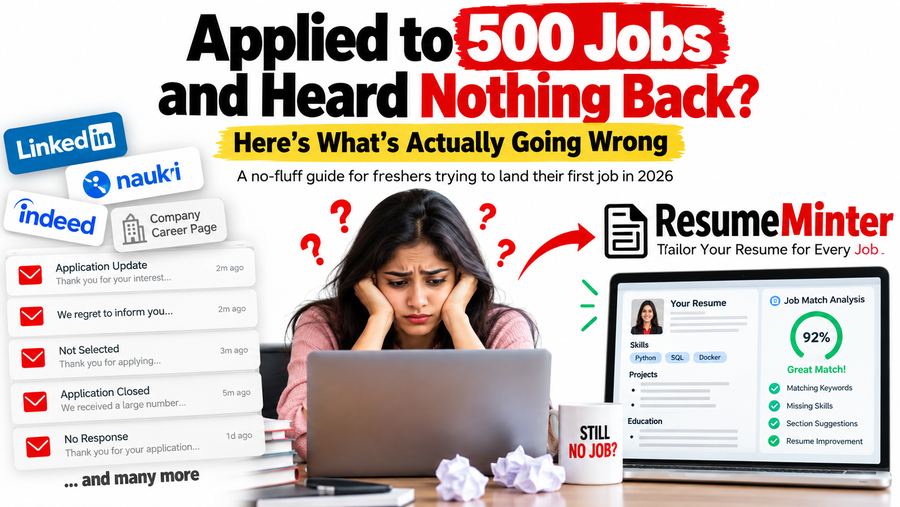
You have projects. You have skills. Your resume looks decent. You've applied to hundreds of jobs on LinkedIn, Naukri, Indeed, and every career page you can find. And the result? Automated rejections, or silence.
If that sounds familiar, you're not alone, and it's probably not because you're underqualified. Most freshers are making a few fixable mistakes that quietly sink their applications before a human ever sees them. Let's fix them.
In this article
- Why applying to 100 jobs a day isn't working
- What employers really want from freshers (that they never say out loud)
- What gets a zero-experience resume noticed
- 7 things that get your resume rejected instantly
- How to write projects that don't sound like a boring task list
- Beyond the resume: what actually gets freshers hired
- The one habit that changes everything
1. Why applying to 100 jobs a day isn't working
More applications feel like more chances. In reality, mass applying often lowers your odds.
When you send 100 applications a day, each one gets a few minutes of attention at most. That means the same generic resume goes everywhere. Meanwhile, recruiters for fresher roles can receive hundreds or even thousands of applications per posting and spend only seconds on each one.
A resume that doesn't obviously match that specific job gets skipped, even if you have every skill they need.
The fix: apply to 10–15 jobs a day, but make each one count. For every application:
- Read the job description and note the key skills and terms it emphasizes
- Use the same wording in your resume for skills you genuinely have (if they say "REST APIs, PostgreSQL, Docker," those exact words should appear)
- Reorder your projects so the most relevant one comes first
Fewer, sharper applications beat a flood of generic ones.
Save time on tailoring: Resume Minter compares your resume against any job description and shows exactly which keywords and sections you're missing, so tailoring takes minutes instead of an hour.
2. What employers really want from freshers (that they never say out loud)
Here's something job descriptions rarely admit: "entry-level" doesn't mean "we'll train you from scratch."
Most teams are busy. Managers are stretched thin, senior employees are already juggling their own work, and nobody has weeks to spend hand-holding a new hire. So when companies hire freshers, they look for one thing above almost everything else: someone who seems teachable and learns fast.
The problem? Every candidate claims to be a quick learner. Very few prove it.
Show moments of self-directed learning
Instead of writing "quick learner" in your skills section, point to a time you actually learned something on your own:
- "Taught myself SQL to analyze survey data for my final-year project"
- "Learned Docker in a week to deploy my team's hackathon app"
Explain how you learn in interviews
When asked about a challenge, walk through your process: what you didn't know, where you looked, and how quickly you got up to speed. That's exactly what hiring managers are listening for.
Translate your degree into the job's language
Your coursework built real skills, but employers won't always connect the dots for you. An English graduate applying for an analyst role isn't "just an English major." They're someone skilled at synthesizing large volumes of information into clear, persuasive findings. Say it that way.
3. What gets a zero-experience resume noticed
Recruiters skim first and read later, if at all. Your best material has to be visible in those first few seconds.
Put projects above education
For most freshers, projects are the strongest proof of ability. A good order is:
- A short skills line matching the job description
- Your 2–3 best projects
- Education
Show that your work is real
The strongest signals on a fresher resume are:
- Projects that are deployed and usable, with a live link
- Evidence of real-world constraints: actual users, data volume, performance, deadlines
- Anything someone else judged: internships, freelance work, hackathon results, open-source contributions
That last point matters more than most freshers realize. It shows your work held up outside your own laptop.
4. 7 things that get your resume rejected instantly
Avoid these, and you're already ahead of a big chunk of the pile:
- Two pages with no experience. Keep it to one.
- An objective statement. "Seeking a challenging role to utilize my skills..." wastes prime space.
- Skill-rating bars. "Java 85%" means nothing to a recruiter.
- A giant skills list with fifteen languages that nothing else on your resume backs up.
- Tutorial clones as major projects. To-do apps, weather apps, and Netflix clones are everywhere.
- Typos, messy formatting, or broken links. A dead GitHub link is an instant red flag.
- The same resume for every job. Recruiters can spot generic from a mile away.
Quick check: not sure if your resume has any of these problems? Run it through Resume Minter against a job you're targeting and see where it falls short before you hit apply.
5. How to write projects that don't sound like a boring task list
This is where most fresher resumes lose momentum. A task list tells recruiters what you did. A strong bullet tells them why it mattered and what was hard about it.
Use this simple formula: what you built + a decision or challenge + the result.
See the difference:
Weaker: "Developed an e-commerce website with login, cart, and payment features."
Stronger: "Built an e-commerce backend handling auth, cart, and Razorpay payments; added Redis caching that cut product-page load time from 1.8s to 300ms."
The second version shows a technical decision, a real integration, and a measurable outcome.
Don't have numbers? Use other concrete details:
- How many people tested or used it
- How much data it handles
- A tricky bug you tracked down
- A trade-off you made and why
Keep it tight: 2–3 bullets per project is plenty. Put your live link and GitHub link right next to the project title, since recruiters click the live link far more often than the repo.
6. Beyond the resume: what actually gets freshers hired
A great resume opens the door. These habits help you walk through it.
Referrals are your biggest advantage. For freshers, a referral can be the difference between a human reading your resume and an automated rejection. Skip the "please refer me" messages to strangers. Instead, reach out to someone at the company (college alumni are easiest), share the specific job ID and your resume in a short message, and make it easy for them to say yes. Many companies reward employees for referrals, so you're not asking for a favor.
Apply early. Applications in the first day or two after a posting goes live tend to perform far better than those sent a week later.
Look beyond crowded portals. Company career pages, off-campus drives, and hiring challenges on platforms like HackerEarth and Unstop often have much less competition than a LinkedIn "Easy Apply" with 2,000 applicants.
Build visibility. Share what you're building on LinkedIn, contribute to open source, or write about a technical problem you solved. It starts slow, but over time recruiters start finding you.
Don't skip DSA. Most service and product companies still test data structures and algorithms in their online assessments. Projects get you shortlisted; DSA gets you through the test.
Know which stage you're failing at. No callbacks means your resume needs work. Interviews but no offers means your interview prep needs work. More applications won't fix either.
7. The one habit that changes everything
If you remember only one thing from this guide, make it this:
Tailor your resume for every application. Read the job description. Pick out the five or six skills and terms it emphasizes. Make sure the ones you genuinely have appear clearly, in the same language, near the top of your resume.
That single habit often separates resumes that get callbacks from those that disappear into the void.
Ready to stop guessing?
Job hunting as a fresher is exhausting, especially when you're doing everything "right" and still hearing nothing back. But the right changes can turn silence into interview calls. Resume Minter helps you tailor your resume to every job in minutes — paste in a job description, and it shows you which keywords are missing, which sections are weak, and how well your resume matches what the employer is looking for.
Keep reading
Stop sending the same resume everywhere
Free ATS score checker — see your match score and missing keywords before you apply, no signup required.
Check my ATS score Build my resume