DA Hike to 63%: How Much Your Salary and Arrears Will Rise (July 2026) for Indian Central Government Employees
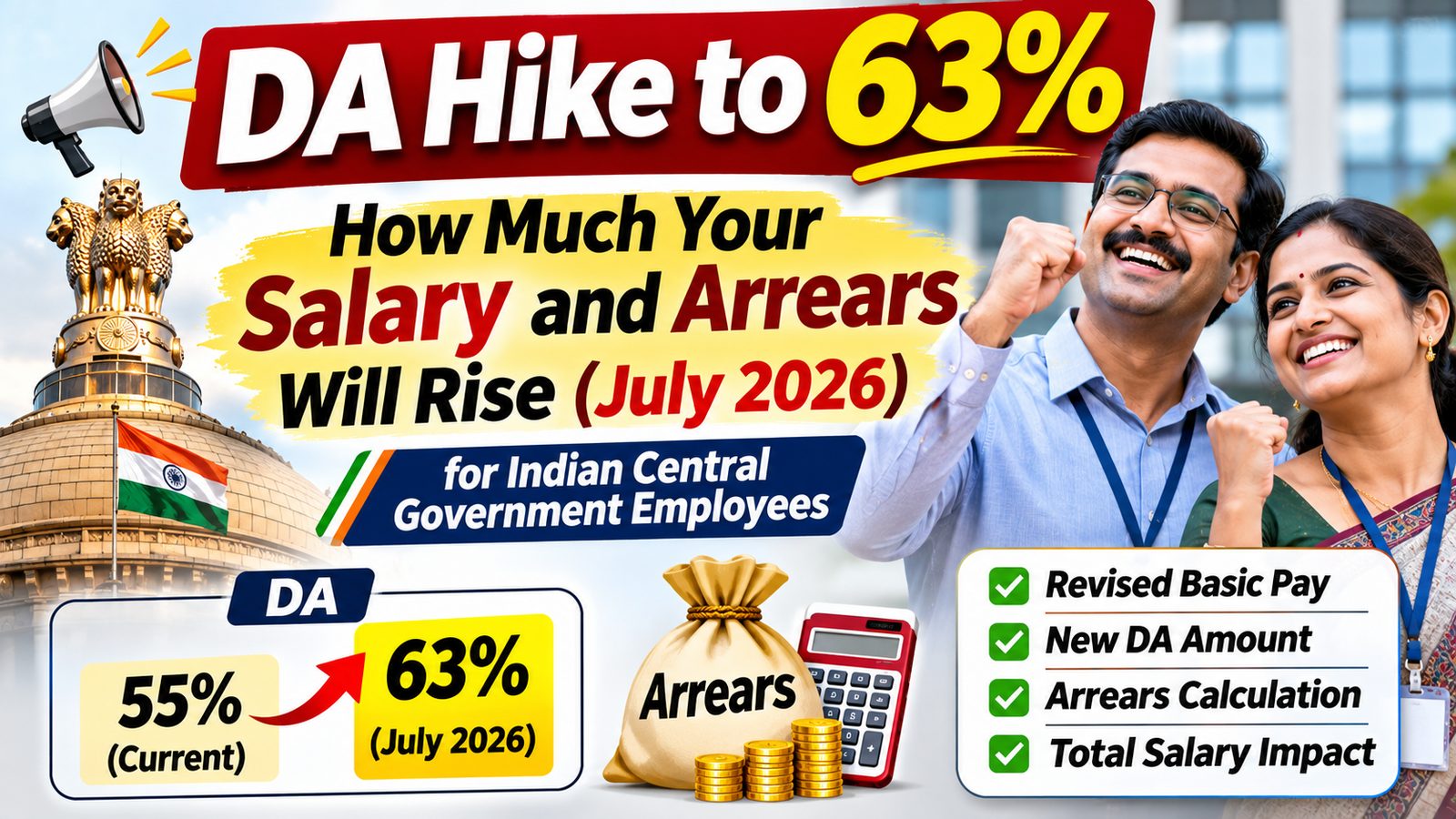
Central government employees and pensioners finally have their July pay boost. On 28 October 2026, the Union Cabinet approved a 3 percentage point increase in Dearness Allowance (DA) and Dearness Relief (DR), taking both from 60% to 63% of basic pay and pension, backdated to 1 July 2026 (PIB).
This guide shows exactly how much more you'll get each month at every pay level, how much arrears to expect and when, what it means for pensioners, and how it fits into the 8th Pay Commission timeline.
The quick answer
- New rate: DA and DR are now 63%, up from 60%, effective 1 July 2026.
- Your monthly increase: 3% of your basic pay (or basic pension). For example, ₹540 a month at the Level 1 entry basic of ₹18,000, and ₹1,347 at Level 7's ₹44,900.
- Arrears: four months (July to October), equal to 12% of your monthly basic — expected with your November salary.
- Who benefits: about 48.54 lakh employees and 68.71 lakh pensioners (PIB).
What the Cabinet approved
| Detail | What was decided |
|---|---|
| Date of approval | 28 October 2026 (PIB) |
| Increase | 3 percentage points over the existing 60% of basic pay/pension (PIB) |
| New rate | 63% DA (employees) and 63% DR (pensioners) |
| Effective from | 1 July 2026 (PIB) |
| Beneficiaries | About 48.54 lakh central government employees and 68.71 lakh pensioners (PIB) |
| Annual cost | ₹10,016.10 crore for DA and DR combined (PIB) |
| Basis | The accepted formula based on the 7th Central Pay Commission's recommendations (PIB) |
Announcing the decision, Information and Broadcasting Minister Ashwini Vaishnaw called it a Diwali gift for employees and pensioners (PSU Watch).
How the rate is set. DA is revised twice a year based on the All-India Consumer Price Index for Industrial Workers (CPI-IW), compensating for price rises. The January 2026 revision took DA to 60%; this July instalment adds 3 points.
A late decision this year. The July revision is usually announced around Dussehra or Diwali; this year it remained unannounced as late as 21 October (PSU Connect), which is why employees will get four months of arrears.
How much your salary will rise: pay-level table
The formula is simple: monthly increase = 3% of your basic pay. DA is calculated on basic pay only, so allowances such as HRA don't change the calculation.
The table uses the entry-level basic pay (first cell) of each 7th CPC pay level. If your basic is higher because of increments or promotions, multiply your own basic by 0.03.
Swipe the table sideways to see every column.
| Pay level | Entry basic pay | DA at 60% | DA at 63% | Monthly increase | Yearly increase | Arrears (Jul–Oct) |
|---|---|---|---|---|---|---|
| Level 1 | ₹18,000 | ₹10,800 | ₹11,340 | ₹540 | ₹6,480 | ₹2,160 |
| Level 2 | ₹19,900 | ₹11,940 | ₹12,537 | ₹597 | ₹7,164 | ₹2,388 |
| Level 3 | ₹21,700 | ₹13,020 | ₹13,671 | ₹651 | ₹7,812 | ₹2,604 |
| Level 4 | ₹25,500 | ₹15,300 | ₹16,065 | ₹765 | ₹9,180 | ₹3,060 |
| Level 5 | ₹29,200 | ₹17,520 | ₹18,396 | ₹876 | ₹10,512 | ₹3,504 |
| Level 6 | ₹35,400 | ₹21,240 | ₹22,302 | ₹1,062 | ₹12,744 | ₹4,248 |
| Level 7 | ₹44,900 | ₹26,940 | ₹28,287 | ₹1,347 | ₹16,164 | ₹5,388 |
| Level 8 | ₹47,600 | ₹28,560 | ₹29,988 | ₹1,428 | ₹17,136 | ₹5,712 |
| Level 9 | ₹53,100 | ₹31,860 | ₹33,453 | ₹1,593 | ₹19,116 | ₹6,372 |
| Level 10 | ₹56,100 | ₹33,660 | ₹35,343 | ₹1,683 | ₹20,196 | ₹6,732 |
| Level 11 | ₹67,700 | ₹40,620 | ₹42,651 | ₹2,031 | ₹24,372 | ₹8,124 |
| Level 12 | ₹78,800 | ₹47,280 | ₹49,644 | ₹2,364 | ₹28,368 | ₹9,456 |
| Level 13 | ₹1,23,100 | ₹73,860 | ₹77,553 | ₹3,693 | ₹44,316 | ₹14,772 |
| Level 13A | ₹1,31,100 | ₹78,660 | ₹82,593 | ₹3,933 | ₹47,196 | ₹15,732 |
| Level 14 | ₹1,44,200 | ₹86,520 | ₹90,846 | ₹4,326 | ₹51,912 | ₹17,304 |
| Level 15 | ₹1,82,200 | ₹1,09,320 | ₹1,14,786 | ₹5,466 | ₹65,592 | ₹21,864 |
| Level 16 | ₹2,05,400 | ₹1,23,240 | ₹1,29,402 | ₹6,162 | ₹73,944 | ₹24,648 |
| Level 17 | ₹2,25,000 | ₹1,35,000 | ₹1,41,750 | ₹6,750 | ₹81,000 | ₹27,000 |
| Level 18 | ₹2,50,000 | ₹1,50,000 | ₹1,57,500 | ₹7,500 | ₹90,000 | ₹30,000 |
Figures are gross amounts before tax and other deductions. Entry basic pay is taken from the 7th CPC pay matrix.
Worked example. A Level 6 employee on a basic of ₹38,700 (an increment above entry) gets ₹38,700 × 3% = ₹1,161 more a month, and arrears of ₹1,161 × 4 = ₹4,644.
Arrears: how much and when
How much. Because the new rate applies from 1 July 2026, you're owed the difference for every month already paid at 60%. If the higher rate starts in your November salary, the arrears cover July, August, September and October — four months:
Arrears = basic pay × 3% × 4 = 12% of one month's basic pay
At Level 1 entry pay that's ₹2,160; at Level 10, ₹6,732; at Level 18, ₹30,000 (see the table above).
When. Reports say employees will receive the July–October arrears with their November salary, though exact timing can vary by department (Meyka, citing Moneycontrol). Payment follows the formal order from the Department of Expenditure, which each ministry and department then processes. If your department's payroll closes before that order arrives, the higher rate and arrears may come a month later — so check with your accounts or payroll section.
If your basic changed during July–October (an increment in July, a promotion or a pay revision), arrears are calculated month by month on the basic you actually drew in each month.
Arrears and tax. Arrears are taxable in the year you receive them. If receiving them pushes you into a higher tax bracket, you may be able to claim relief for salary arrears relating to earlier years; for arrears that fall within the same financial year (as here, July–October 2026), they simply add to this year's income. Check with your DDO or a tax adviser if you're unsure.
Pensioners: how much your Dearness Relief rises
Pensioners and family pensioners get the same 3-point increase as Dearness Relief (DR), from 60% to 63% of basic pension, from 1 July 2026 (PIB). About 68.71 lakh pensioners benefit.
Swipe the table sideways to see every column.
| Basic pension | DR at 60% | DR at 63% | Monthly increase | Arrears (Jul–Oct) |
|---|---|---|---|---|
| ₹9,000 (minimum pension) | ₹5,400 | ₹5,670 | ₹270 | ₹1,080 |
| ₹15,000 | ₹9,000 | ₹9,450 | ₹450 | ₹1,800 |
| ₹25,000 | ₹15,000 | ₹15,750 | ₹750 | ₹3,000 |
| ₹50,000 | ₹30,000 | ₹31,500 | ₹1,500 | ₹6,000 |
| ₹75,000 | ₹45,000 | ₹47,250 | ₹2,250 | ₹9,000 |
| ₹1,25,000 | ₹75,000 | ₹78,750 | ₹3,750 | ₹15,000 |
Good to know
- DR is on your full basic pension, not the reduced amount after commutation.
- Pension arrears are credited by your pension disbursing bank or authority once it processes the order; check your bank statement or pension slip in November–December.
- Additional pension for older pensioners (for those aged 80 and above) is part of basic pension, so DR applies to it too.
Other allowances, deductions and who's covered
What changes and what doesn't
| Item | Effect of the DA hike |
|---|---|
| Basic pay | No change — DA is added on top |
| HRA | No change from this hike; HRA rates are linked to DA thresholds, not each revision |
| Transport allowance | Rises slightly, because transport allowance also carries DA |
| NPS/UPS contributions | Rise slightly, because contributions are calculated on basic pay plus DA — so your in-hand increase is a little less than the gross figure, while the government's contribution to your pension account also rises |
| Income tax/TDS | Rises in line with the higher taxable salary |
Who is covered. This decision applies to central government employees and central pensioners. Others follow their own schedules:
- State government employees: each state announces its own DA, often after the Centre; check your state finance department's order.
- Bank, PSU and autonomous body employees: many follow different DA formulas or separate approvals, so the Centre's 63% doesn't automatically apply.
- Defence personnel and defence pensioners are covered as central government employees and pensioners, with orders issued through their own pay and pension channels.
What this means for the 8th Pay Commission
Where things stand. The 8th Central Pay Commission was set up on 3 November 2025 under Justice Ranjana Prakash Desai (TimesBull) — one year ago today. Its consultations are still under way; holding meetings in cities such as Mumbai doesn't mean it has reached conclusions (Sunday Guardian). Its report is expected around mid-2027 (Outlook Money).
What employees are asking for. Railway unions have demanded a minimum basic pay of ₹69,000; this remains a union demand, while the 63% DA is an approved government decision (Sunday Guardian).
No DA merger for now. The government has dismissed rumours of merging DA with basic pay (Outlook Money), so DA continues to be revised twice a year under the 7th CPC formula until the new pay structure arrives.
Why 63% matters later. When a new pay commission is implemented, the accumulated DA is typically built into the new basic pay through the fitment factor, and DA restarts from zero. A higher DA today therefore raises the bar the 8th CPC's fitment factor needs to clear to deliver a real increase.
What comes next
| When | What to expect |
|---|---|
| November–December 2026 | Higher DA and July–October arrears in salaries and pensions |
| Around March 2027 (typical timing) | Announcement of the January 2027 DA revision, based on CPI-IW data |
| Around mid-2027 (expected) | 8th Pay Commission report |
| After government acceptance | New pay matrix, with arrears from the effective date the government fixes |
Frequently asked questions
What is the new DA rate? 63% of basic pay, up from 60%, effective 1 July 2026 (PIB).
How do I calculate my increase? Multiply your basic pay by 0.03. For arrears, multiply that by the number of months paid at the old rate — usually four (July to October).
When will I get the arrears? Reportedly with the November 2026 salary, though timing can vary by department (Meyka, citing Moneycontrol). Ask your payroll section if it doesn't appear.
Is DA calculated on gross salary? No. DA is calculated on basic pay only (and DR on basic pension).
Does this apply to state government employees? Not automatically. States announce their own DA revisions.
Will DA be merged with basic pay? The government has dismissed merger rumours (Outlook Money). DA is normally absorbed into basic pay only when a new pay commission is implemented.
When is the next DA hike? The next revision is due from 1 January 2027, typically announced around March, based on CPI-IW inflation data.
The bottom line
The 3-point DA and DR hike adds 3% of basic pay to every central employee's and pensioner's monthly income — from ₹540 at Level 1 to ₹7,500 at Level 18 at entry pay — plus four months of arrears worth 12% of a month's basic. It keeps pay in step with inflation while the 8th Pay Commission works towards a wider revision expected after its report in 2027. Check your November payslip, and raise any missing arrears with your accounts section.
Preparing for a central government job? See our guides to upcoming government exams and how to apply, and build your CV free on ResumeMinter.