Failed the UAE Medical Fitness Test? What Happens Next
You've accepted a UAE job, completed your medical test, and then you're told the result is "unfit". It's one of the most frightening moments in the whole visa process — and one of the worst-served online. Search for it and you'll find forum threads mixing up different Gulf countries, and agency pages repeating the same phrase without explaining anything.
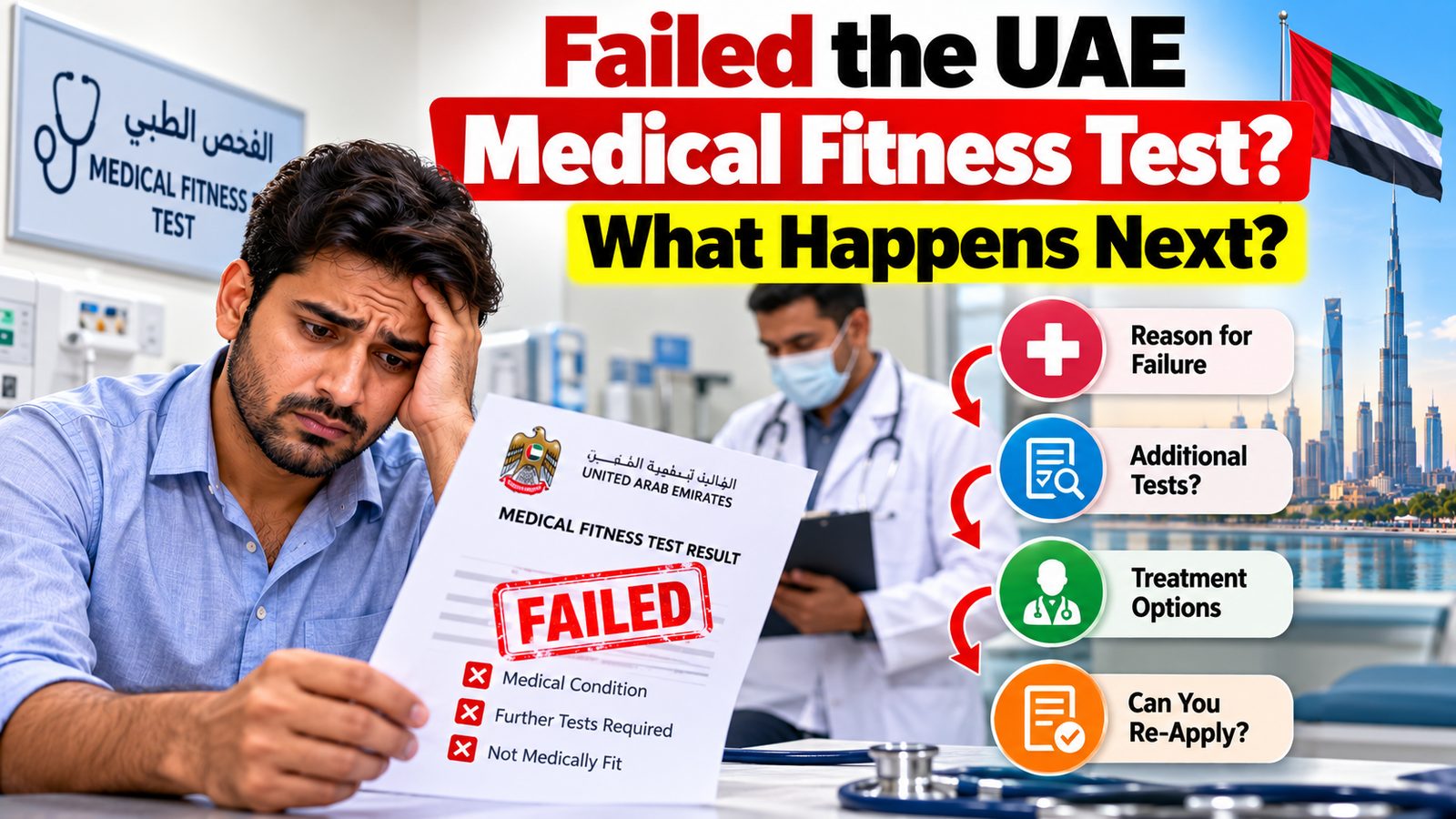
Here's the reassuring part: an unfit result doesn't always mean the end of your UAE plans. What happens next depends on which condition was found, whether you're a new applicant or renewing, and in some cases your job. Some outcomes are final; others allow treatment, a retest, a job-category change or an exemption.
This guide explains what the test checks, what happens for each condition according to the official UAE Government portal, what an unfit result means for your visa and job, how retests and appeals work, and your rights to privacy. It's general information, not medical or legal advice — always confirm your own case with the medical centre and the health authority that tested you.
What the medical fitness test checks
Foreigners planning to work or live in the UAE must undergo medical tests to confirm their health before residency procedures can proceed. The rules come from Cabinet Resolution No. 5 of 2016, which amended Cabinet Decree No. 7 of 2008 on expatriates' medical examinations (u.ae).
For everyone applying for or renewing residence:
- HIV
- Tuberculosis (TB), usually via chest X-ray
- Leprosy
- Hepatitis B and syphilis tests are also listed in the official schedule (u.ae)
Extra checks for certain jobs. Workers in specific roles must also test negative for syphilis and Hepatitis B: domestic workers (housemaids, nannies, drivers), food handlers and restaurant or café staff, nursery and school staff, and workers in salons, beauty centres and health clubs (Henry Club). Female domestic workers also take a pregnancy test (u.ae). Hepatitis B vaccination is obligatory for several of these categories, including domestic workers, nursery staff, salon and health-club workers, and health facility staff (EGSH).
Who runs the tests. Testing is done by Dubai Health in Dubai, SEHA in Abu Dhabi and Emirates Health Services (EHS) in the northern emirates (Dubai Visits Visa).
Three possible results. Your result will be fit (the visa proceeds), unfit (the visa is refused), or a conditional certificate for certain TB cases (Henry Club). In Dubai, you can check your status on the Dubai Health "Check Medical Fitness Status" service or app using your reference number and date of birth.
It's not a general health check. Conditions like diabetes or high blood pressure aren't part of this screening.
What happens for each condition
| Condition | New applicant | Renewing resident |
|---|---|---|
| HIV | Residency denied (u.ae) | Residency not renewed (u.ae) |
| Leprosy | Residency denied (u.ae) | Residency not renewed |
| Tuberculosis (TB) | Old pulmonary or active TB has been treated as unfit for new applicants (Gulf News), though certain individuals may qualify for exemptions with monitoring (L&Y Lawyers) | TB scars, active TB or drug-resistant TB lead to a conditional certificate with a one-year visa and treatment inside the UAE (Gulf News) |
| Hepatitis B and C | Affects only certain occupations; if positive in a covered job, residency isn't granted unless you change job category within 30 days (L&Y Lawyers) | Same rule for covered occupations |
| Syphilis | Part of the occupational panel for domestic workers, food handlers, nursery and salon staff (Henry Club) | Ask the medical centre what applies to your case |
| Pregnancy | Tested for female domestic workers only (u.ae) | — |
Tuberculosis: the most common "unfit" worry
TB causes the most confusion, partly because the rules for new applicants and renewals differ.
- If you're renewing: under the 2016 Cabinet resolution, residents found with TB scars, active TB or drug-resistant TB get a conditional fitness certificate and a one-year visa, and must undergo treatment within the UAE with follow-ups at preventive health centres. Residents who don't comply with the treatment protocol are then considered unfit (Gulf News). For drug-resistant TB, the official portal says the person is treated in the UAE until recovery, after which residency may be renewed (u.ae).
- If you're a new applicant: the rules are stricter, and an X-ray showing old or active TB can lead to an unfit result. Some individuals are exempt but require monitoring (L&Y Lawyers). If you've had TB before, consider getting checked and treated at home first, and carry your treatment records.
- If you were banned because of TB scars: a Khaleej Times legal column describes a route to request lifting the ban by getting a medical fitness report from a government-approved centre stating you have no TB-related scars or illness, notarising and legalising it, and submitting it to the medical fitness centre that tested you (Khaleej Times).
Hepatitis B: depends on your job
If you work in an office role, Hepatitis B usually isn't part of your screening at all. It matters for domestic workers, food handlers, nursery and school staff, salon and health-club workers and healthcare staff. If you test positive in a covered role, the 30-day window to change job category is the key option to discuss with your employer (L&Y Lawyers).
What an unfit result means for your visa and job
If you're a new applicant on an entry permit: your residence visa can't be issued while the result is unfit. You entered on an entry permit to complete residence procedures, so you'll need to resolve the result (through a review or a conditional route, where available) or leave the UAE before your permit's time runs out.
If you're renewing: an unfit result means your residence isn't renewed, unless a conditional route applies (as for many TB cases). Once your current visa expires or is cancelled, the grace period rules apply; see our guide Grace Period After UAE Visa Cancellation: The Real Rules.
If you get a conditional certificate: you'll typically receive a one-year visa and must follow the treatment and follow-up plan. Missing follow-ups can turn a conditional result into an unfit one (Gulf News).
Your job offer. Most UAE offers are conditional on obtaining a residence visa, so an unfit result can end the offer. But if a conditional route or a job-category change is possible — for example, moving from a food-handling role to a non-covered role within 30 days for Hepatitis B — ask your employer whether they'll support it in writing.
Your family. Dependants also take medical tests when you sponsor them. If a family member's result is unfit, their residence is affected individually; it doesn't automatically affect yours.
Timing matters. Medical fitness certificates are valid for three months; if they aren't used for visa processing in that time, the tests must be retaken (L&Y Lawyers). Results are recorded in a centralised system, so retesting at a different centre won't hide a previous result.
Retests, reviews and appeals
There's no single published "appeal" procedure that covers every emirate and condition, but these are the practical routes:
- Get the exact finding. Ask the medical fitness centre what was found, which test it came from, and whether further tests are needed. An "unfit" label alone tells you nothing about your options.
- Ask about confirmatory tests. Screening results can be followed by further assessment — for TB, for example, referral for clinical review rather than a final decision on the X-ray alone (Takween Advisory).
- Raise errors with the authority. If a result looks wrong, raise it directly with the medical fitness centre and the health authority (Dubai Health, SEHA or EHS); only the authority can review or re-issue a result (Henry Club). Private hospital results generally can't replace an approved government centre's result.
- Use condition-specific routes. For TB on renewal, the conditional certificate and treatment pathway; for Hepatitis B in covered jobs, the 30-day job-category change; for a TB-scar ban, the legalised medical report route described above.
- Get professional advice for serious cases. For complex medical or immigration questions, speak to a doctor at the health authority and, if needed, a licensed UAE lawyer.
What doesn't work: retesting at another centre in the hope of a different result (results are centralised), resubmitting the same visa application unchanged, or paying anyone who promises to "clear" your medical.
Your privacy and rights
Your health information is yours. Your employer needs to know whether you're medically fit for the visa, not necessarily your diagnosis. You don't have to share medical details beyond what the process requires.
Get proper care. An unfit result can be a shock, but it may also be the first sign of something that needs treatment. TB, Hepatitis B and syphilis are treatable or manageable conditions. See a doctor — in the UAE or at home — for proper follow-up, whatever happens with your visa.
Don't pay "fixers". Be wary of agents or individuals offering to change a medical result, get you a "fit" certificate, or guarantee a visa despite an unfit result for a fee. Only the health authority can review or re-issue a result (Henry Club), and paying for a falsified result can lead to serious legal trouble.
Who pays for the test. Medical tests for an employment visa are part of the employer's recruitment costs, which employers can't pass on to workers under UAE labour law (Gulf News). If you're asked to pay for your own medical, ask your employer to cover it.
Before you travel next time. If you have a history of TB or another listed condition, get checked and treated at home first, keep your treatment records, and be open with your employer early so they can plan around it.
What to do now: checklist
- Get the exact finding and test name from the medical fitness centre
- Check whether you're treated as a new applicant or a renewal — the rules differ, especially for TB
- Ask about confirmatory tests, a clinical review or a conditional certificate
- For Hepatitis B in a covered job, discuss a job-category change within 30 days
- Note your visa and grace-period deadlines
- Talk to your employer about your offer, in writing
- See a doctor for follow-up care
- Ignore anyone offering to "fix" your result for money
The bottom line: a failed UAE medical test is serious, but it isn't always final. HIV and leprosy lead to denial; TB and Hepatitis B often have conditional or job-based routes; and errors can be reviewed by the health authority. Get the facts from the medical centre first, act within the deadlines, and look after your health whatever the visa outcome. If you need to restart your job search, build a UAE-ready CV free on ResumeMinter.