The Indian Job Market in 2026: What's Really Happening, and How Freshers Can Stay Ahead
The headlines say hiring is up. Your inbox says otherwise. Here's how both can be true, and what you can do about it.
Published: September 30, 2026 · Written by the Resume Minter team
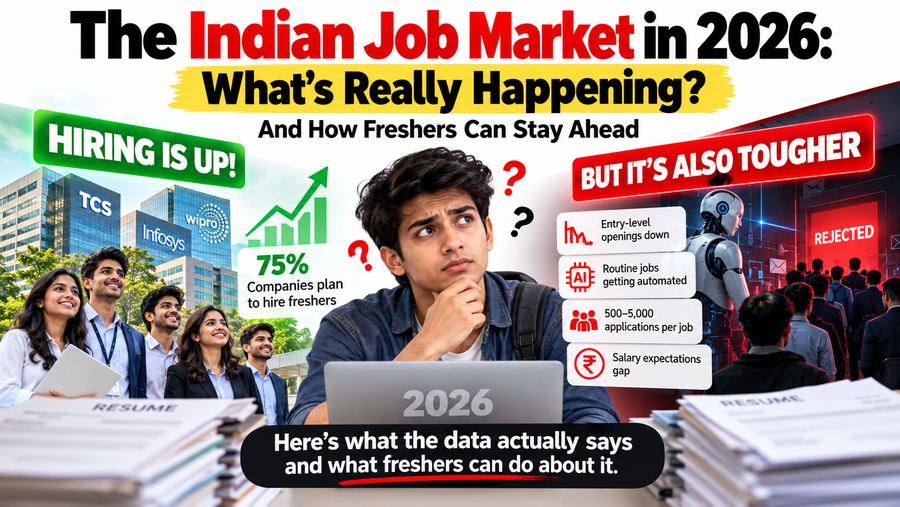
If you've been following job news in 2026, you've probably seen two very different stories. One says companies are eager to hire freshers. The other says entry-level jobs are shrinking because of AI. Both are partly right, and understanding why is the first step to getting ahead.
In this article
1. The good news: companies still want freshers
Let's start with the positives, because there are real ones.
75% of employers plan to hire freshers between July and December 2026, a slight rise from 73% in the first half of the year. E-commerce and tech start-ups, along with retail, show the strongest intent at 93% each, with manufacturing close behind at 89%. FMCG also stands out, with 86% of employers planning to bring in freshers this half-year.
Job portal data backs this up: hiring for the 0–3 years experience band grew 17% year-on-year in February, and fresher hiring was up 8% year-on-year in June 2026.
So no, entry-level jobs haven't disappeared.
2. The reality check: hiring is selective, not scarce
Here's the part that explains your silent inbox: high hiring intent doesn't mean easy hiring.
The reason so many freshers remain unplaced despite strong demand is that hiring has become selective rather than scarce. Overall employability stands at 56.35%, which means close to 44% of assessed young people still aren't considered job-ready.
There's also a salary expectations gap: 73% of undergraduates expect more than ₹5 LPA, but only 40% actually get it.
And application volumes are brutal. Major Indian companies receive anywhere from 500 to 5,000 applications per fresher opening.
3. The IT sector is changing shape
If you're a CS or IT graduate, this section matters most.
The old model of IT services, hiring thousands of freshers, training them for months, and deploying them on routine projects, is fading. IT firms' hiring intent dropped to 76% in the second half of 2026 from 81% in the first half, and large companies are moving away from hiring huge batches of graduates just to build bench strength.
The squeeze shows up clearly in the numbers: entry-level tech openings (0–2 years) were at just 10,000 in June 2026, a 44% drop compared to June 2025. The work being automated first includes manual testing, Tier-1 support, data entry, and basic CRUD coding — the very tasks freshers used to learn on.
Two other trends worth watching:
- Experience creep. Some roles labeled "fresher" now effectively expect two to three years' worth of practical project experience.
- Delayed onboarding. There have been reports of pushed-back joining dates, and some cancelled offers, as firms match hiring more tightly to immediate project needs.
That said, the big players haven't stopped hiring. For FY26, TCS said it expected to hire around 40,000 freshers, Infosys planned over 20,000, and Wipro guided to 10,000–12,000. The mass-recruiter path still exists — it's just no longer the only road.
4. Where the opportunities are growing
A great resume opens the door. Knowing where to point it opens more of them.
AI and ML roles
AI/ML roles were up 34% in January, and this momentum has held through the year. AI Application Developer, Junior Semiconductor Design Engineer, and Data Centre Operations Associate are among the leading fresher roles.
Global Capability Centres (GCCs)
The India offices of global firms are a bright spot. An estimated 1.2–1.4 lakh net new GCC roles could be added in 2026, and these jobs tend to pay better and be more technically demanding, though they're harder to crack without cloud, data, or AI skills.
Non-IT sectors
Don't limit yourself to software companies. Early 2026 saw BPO/ITES hiring up 21%, hospitality and travel up 15%, insurance up 7%, and healthcare up 5%.
Specialised skills and tier-2 cities
Employers are showing growing demand for full-stack engineering, cloud security, business analytics, healthcare technology, and sustainability/ESG skills. And you don't need to be in a metro to catch the wave: Bengaluru still leads with about 34% of tech hiring activity, followed by Hyderabad at 19% and Pune at 13%, but tier-2 cities are growing too, with hiring gains in cities like Jaipur (12%), Coimbatore (11%), Indore (9%), and Surat (15%).
5. The biggest shift: skills over scores
This is the change that matters most for your job search.
Hiring is moving away from qualification-led recruitment toward capability-led hiring. In practice, that means companies are dropping strict CGPA cutoffs in favour of practical coding assessments, portfolio reviews (GitHub, Kaggle, personal projects), and aptitude tests combined with technical depth.
Project-based hiring has risen 38% over the past year, so a project link now carries more weight in screening than before.
AI is also doing more of the screening: 71% of Indian recruiters now use AI to find talent, and 80% say it makes assessing candidate skills easier. Your resume increasingly has to make sense to software before it reaches a human.
Get screened by AI, not filtered out by it: Resume Minter compares your resume against any job description the way an ATS or recruiter AI would, and shows you exactly which keywords and sections are missing before you hit apply.
6. How to stay ahead in the 2026 job market
Here's how to turn all of this into an action plan.
Build proof, not just a skills list. Employers want evidence. One deployed project that solves a real problem beats five tutorial clones. Add live links, clean GitHub READMEs, and concrete results ("reduced load time by 60%," "used by 200 classmates").
Learn to work with AI tools. The skills showing up again and again are AI and generative AI tool fluency, cloud computing, cybersecurity, and full-stack development depth. You don't need to become an ML researcher, but knowing how to use AI coding assistants well, and being able to show it in a project, is quickly becoming baseline.
Chase internships seriously. Internships are one of the most reliable doors in, with internship-to-PPO conversion rates around 31%. Even a short internship gives you the "real experience" that experience-creep job descriptions ask for.
Widen your target list. Look beyond big IT services firms. Start-ups, GCCs, e-commerce, fintech, healthtech, and even non-tech companies undergoing digital transformation all need tech-savvy freshers. Consider roles in tier-2 cities too, where competition can be lighter.
Keep DSA and aptitude sharp. Skills-first hiring means more assessments, not fewer. Online coding rounds and aptitude tests are still the gatekeepers at most companies.
Tailor every application. With hundreds or thousands of applicants per opening and AI screening in the mix, a generic resume is almost invisible. Match your resume's wording to each job description, lead with your most relevant project, and apply early after a posting goes live.
Keep a backup plan during offer delays. If you have an offer with a delayed joining date, keep interviewing, keep upskilling, and keep building. Don't put your search on hold for a date that might move.
Track the market monthly. Keep an eye on monthly hiring reports from job portals and staffing firms. Knowing which sectors and cities are growing lets you shift your focus before everyone else does.
7. The bottom line
The 2026 job market isn't closed to freshers. It's just less forgiving. Companies are still hiring, but they want candidates who can show real skills from day one, and they're using smarter tools to find them.
The freshers who win this year aren't the ones who apply to the most jobs. They're the ones who apply smart: strong proof of work, relevant skills, and a resume that clearly matches each role.
Make your resume match what 2026 employers want: with AI screening and skills-first hiring now the norm, your resume has to prove your fit in seconds, for every single job. Tailor each application in minutes with Resume Minter instead of hours.
Keep reading
The market rewards the prepared
Free ATS score checker — see your match score and missing keywords before you apply, no signup required.
Check my ATS score Build my resume