UAE Employment Visa Rejected? The Real Reasons and How to Fix Each
Your offer letter is signed, you've told your current employer you're leaving, and then HR sends the message every candidate dreads: your UAE employment visa application has been rejected. Often there's no reason given.
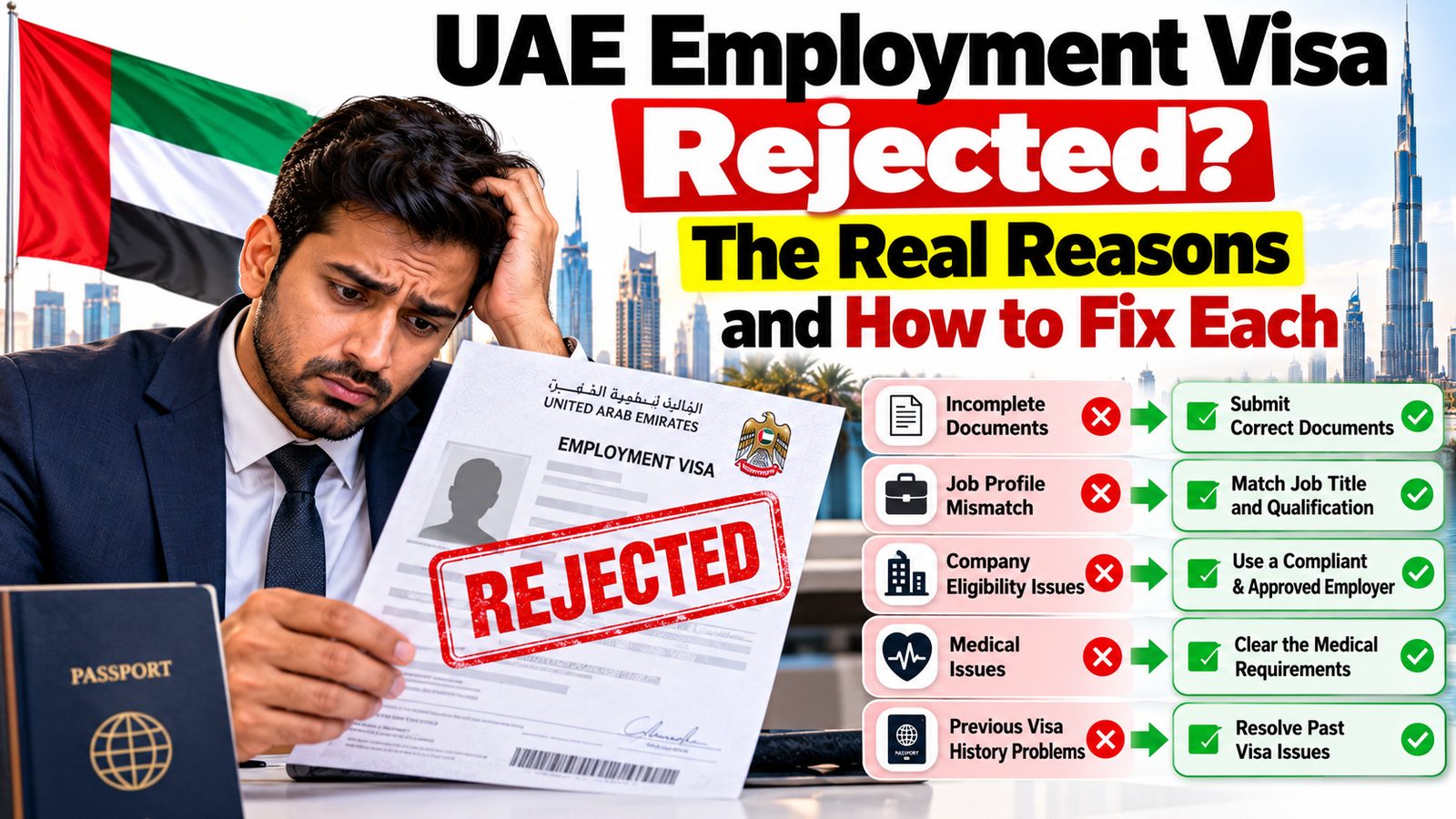
A rejection is rarely random. A UAE employment visa passes through several separate checks — the MoHRE work permit, the entry permit, a medical test, a security check and the residence visa — and any one of them can stop the file. Some causes are on your side, some sit entirely with your employer, and most can be fixed once you know which check failed.
This guide explains each stage, the real reasons applications fail — drawn from official UAE government sources wherever possible — how to find out why yours was rejected, and exactly what to do next. It's written for candidates, especially those moving from India, but HR teams will find it useful too.
The five checks every employment visa passes
A UAE residence or work file passes several gates: the MoHRE work permit, the entry permit from ICP or GDRFA Dubai, the medical, a security check and the residence visa. Any of them can stop it, and the status rarely says which (Sarmat).
Knowing which stage failed is half the fix. A refusal at the work permit stage is usually the employer's problem; a refusal at the entry permit or security stage is usually about you; and a medical failure follows its own rules.
Rejected or returned? These aren't the same. A returned application was sent back for correction — a blurred scan, a missing page or a wrong field — so you fix it and resubmit. A rejected application was refused, and the practical route is a new application once the cause is fixed (Sarmat).
Reasons on your side — and how to fix each
| Reason | What happens | Fix |
|---|---|---|
| Security check flag | Every residence applicant must pass a security check; the criteria aren't published, so these rejections often come without explanation (Sarmat) | Rule out an open case, unpaid fine or absconding report first. If none apply, raise it with ICP or GDRFA (see below), ideally with a UAE lawyer. Resubmitting the same file unchanged rarely helps |
| Old overstay or unfinished cancellation | Overstay fines are AED 50 a day, and an old file left open can block a new one (Sarmat) | Pay outstanding fines and make sure any previous UAE visa was properly cancelled before refiling |
| Absconding report | Employers must report absconding within 10 days, and a false report carries an AED 5,000 fine (Sarmat, citing GDRFA) | Challenge a false report through MoHRE or GDRFA, with proof of your employment record, before refiling |
| Name spelled differently across documents | Passport, degree and offer letter don't match — a common problem in practice (Sarmat) | Treat your passport as the master spelling and make every document match it |
| Photo doesn't meet standards | ICP asks for a recent, high-quality photo on a white background, meeting ICAO standards, with no hats or sunglasses (Sarmat) | Retake it at a studio that knows ICAO specifications |
| Documents not attested | Degrees issued abroad must be authenticated in the country of origin and by the UAE embassy or consulate there, and some professions need UAE ministry attestation too (Sarmat) | Complete the full attestation chain before applying; never submit a certificate you can't trace to its issuer |
| Missing good conduct certificate | For some nationalities, ICP now lists an attested certificate of good conduct among the documents for employment visas, phased in during 2026 (Sarmat) | Ask your employer whether your nationality is covered, then get the certificate and its attestation at home first |
| Passport validity | Your passport must be valid for at least six months (Sarmat, citing ICP) | Renew your passport before the process starts |
For Indian applicants: start degree attestation as soon as you accept an offer — it often takes the longest. Check that your name matches exactly across your passport, degree, mark sheets and experience letters, and keep your Indian police clearance and other documents ready in case your employer asks.
Reasons on your employer's side
Sometimes the problem has nothing to do with you. MoHRE, the labour ministry, issues work permits only when the employer meets set conditions. According to the official UAE Government portal, the conditions include (u.ae):
- The worker must be at least 18 (except juvenile and student permits).
- The occupation must be aligned with the business activity of the establishment.
- The company's trade licence must be valid and free of violations.
- The worker must meet licensing conditions for specialised professions (such as healthcare, engineering or law).
MoHRE may also refuse, not renew or cancel work permits if the employer provides incorrect documents, is fictitious or doesn't carry out its registered activity, or isn't compliant with the Wage Protection System (WPS) or other labour market systems (u.ae).
Companies can also be blocked from new permits altogether for serious violations, including breaches listed in MoHRE's fines resolution, failing to provide proper labour accommodation, human trafficking allegations, or misusing MoHRE systems (u.ae).
| If this is the cause | What it looks like for you | What to do |
|---|---|---|
| Your job title doesn't match the licence | A refusal at the work permit stage | Ask HR to change the title to one that matches a licensed activity, or to add the activity to the licence |
| Company violations, unpaid fines or WPS problems | Delays or a refusal, often with no clear reason given to you | Ask HR directly whether the company file has open violations; only the employer can fix this |
| Specialised profession not licensed | Healthcare, engineering or legal roles stuck before approval | Complete the professional licensing (for example, the relevant health authority licence) first |
A warning sign: if an employer can't get you a work permit and asks you to start working on a visit visa meanwhile, don't. Working without a valid permit is illegal under UAE labour law (u.ae), and it puts you at risk, not just the company.
Medical fitness failures
Residence applicants aged 18 and over must take a medical fitness test. The official screening list covers HIV, Hepatitis B, leprosy, syphilis and TB (plus pregnancy for domestic workers) (Sarmat, citing u.ae).
| Condition | What happens |
|---|---|
| HIV or leprosy | Residency is denied or not renewed for positive cases (Sarmat, citing u.ae) |
| Tuberculosis (TB) | Assessed case by case. People with old or active pulmonary TB are initially considered unfit, but certain individuals may be exempt, with ongoing monitoring mandatory (L&Y Lawyers) |
| Hepatitis B and C | Tested only for specific professions, such as medical staff. If positive, residency isn't granted or renewed unless the applicant changes job category within 30 days (L&Y Lawyers) |
What to do if your medical result is unfit
- Ask the medical centre exactly what was found and whether a retest, further tests or a medical committee review is available.
- Don't let anyone refile blindly. Clarify the result first; a new application with the same result will fail again.
- For TB scars or past TB, ask about the exemption and monitoring process. If an immigration ban was imposed over TB scars, there's a route to request it be lifted by submitting a legalised medical fitness report from a government-approved centre showing no TB-related scars or illness (Khaleej Times).
- For Hepatitis B in a covered profession, discuss with your employer whether a change of job category is possible within the 30-day window.
- Remember the timing: medical fitness certificates are valid for three months; if not used within that period, tests must be retaken (L&Y Lawyers).
Medical results are personal health information. You aren't obliged to share details with anyone beyond what the process requires.
How to find out why your visa was rejected
Step 1: Ask whoever filed it. Your employer's PRO, HR team or typing centre holds the application details and the exact status message. Ask for a screenshot of the status and the application number.
Step 2: Identify the stage. Was it the MoHRE work permit, the entry permit, the medical or the residence stage? The table and diagram above show what usually fails at each.
Step 3: Contact the right authority. GDRFA handles Dubai, and ICP covers Abu Dhabi, Sharjah, Ajman, Umm Al Quwain, Ras Al Khaimah and Fujairah (Sarmat, citing u.ae).
| Authority | Contact |
|---|---|
| ICP (all emirates except Dubai) | Call centre 600 522 222; Customer Voice Gateway at cc.icp.gov.ae (ICP) |
| GDRFA Dubai | AMER line 800 5111 inside the UAE, +971 4 313 9999 from abroad (Sarmat) |
| MoHRE (work permit issues) | MoHRE app, website or call centre 600 590000 (Gulf News) |
Step 4: Check for blocks in your name. Ask whether there's an open case, unpaid fine, absconding report or unfinished cancellation on record. These are the most common hidden causes.
Step 5: Fix, then reapply. There's no published waiting period before reapplying — reapply once the cause is fixed, not before (Sarmat).
Is a rejection a ban? Not necessarily. A rejection is a decision on one application; ask GDRFA or ICP whether any wider restriction is on record (Sarmat).
Fees, refunds and your rights
Who pays. Under UAE labour law, employers can't charge workers recruitment and employment costs, directly or indirectly (Gulf News). If your visa is rejected and the employer refiles, the cost of refiling shouldn't fall on you. If anyone asks you to pay for your visa, work permit or medical test, treat it as a red flag.
Refunds. Don't count on getting government fees back. One UAE visa services firm reports finding no published rule refunding fees on rejected residence or employment applications (Sarmat). This is another reason to fix the cause before refiling.
Your job offer. A rejection doesn't automatically cancel your offer, but many offers are conditional on obtaining a visa. If the problem is fixable — a document, a job title, a company issue — ask your employer to commit in writing to reapplying once it's resolved, and confirm your start date will move accordingly.
Don't resign too early. Wherever possible, wait until your work permit (and ideally your entry permit) is approved before resigning from your current job.
Beware of "fixers". Be cautious of agents promising to clear a security rejection or remove a ban for a fee. Work through official channels, your employer's PRO, or a licensed UAE lawyer.
Prevention checklist before your employer applies
- Passport valid for at least six months, and its spelling used on every document
- Degree and experience certificates fully attested
- Good conduct certificate obtained and attested, if your nationality is covered
- ICAO-standard photo on a white background
- No open fines, overstays or unfinished cancellations from previous UAE visas
- Job title on the offer letter matches the employer's licensed activity
- Professional licence arranged for regulated roles
- Medical test booked promptly, results understood
- Offer verified through MoHRE; no fees paid by you
- Current job not resigned until the work permit is approved
The bottom line: most UAE employment visa rejections have a specific, fixable cause — a document, a name, an old fine, a job title, or a problem in the employer's file. Find out which check failed, fix that one thing, and only then reapply. If you're re-entering the job market after a rejection, keep your CV ready: build a UAE-ready CV free on ResumeMinter.