India's Job Market in 2027: The Real Statistics Behind the Hiring Headlines
Headline hiring numbers look healthy. But landing a stable, well-paid job that matches your degree is getting harder, especially if you're young. Here's what the data actually shows, and what to do about it.
Published: October 12, 2026 · Written by the Resume Minter team
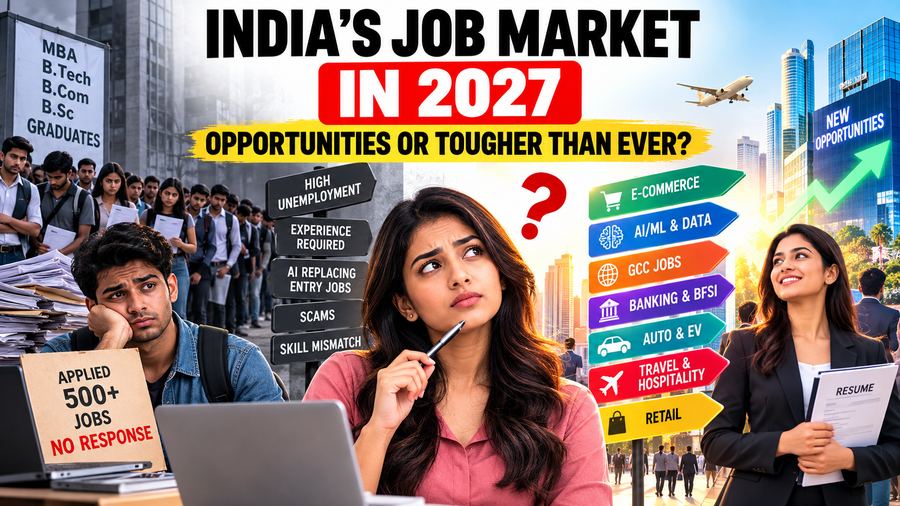
India's job market heading into 2027 is a two-speed market. The headline hiring numbers look healthy. But the "good job" -- stable, salaried, fairly paid, and matching your degree -- is getting harder to land, especially if you're a young graduate.
Most of the hard data below runs through mid-to-late 2026, and the forward-looking surveys only cover up to March 2027, so treat anything beyond that as projection rather than fact.
In this article
- The headline picture looks fine
- Challenge #1: Far more graduates than graduate jobs
- Challenge #2: Finding a job doesn't mean finding a good one
- Challenge #3: The IT entry rung is shrinking
- Challenge #4: The "experience required" trap
- Challenge #5: The AI skills mismatch
- Challenge #6: The government-job route has lost trust
- Challenge #7: Scams are everywhere
- The deeper structural challenges
- Where the opportunities are for 2027
- What this means if you're job-hunting
- The bottom line
The headline picture looks fine
Start with the good news, because there is some. Employers surveyed by TeamLease project workforce growth of 5.4% between October 2026 and March 2027, led by e-commerce, tech start-ups, travel, hospitality and retail. That's higher than the 4.7% recorded in the previous six months and 4.4% a year earlier.
Naukri's hiring index showed white-collar hiring up 14% year-on-year in August 2026, though Naukri itself cautioned that the number should be read alongside the festive calendar shifting from August last year to September this year, which inflates the comparison. Officially, labour force participation hit 55.6% in August 2026, and unemployment eased to 5.0%.
So why do so many people feel stuck? Because the averages hide where the pain actually is. The rest of this article is about that gap.
Challenge #1: Far more graduates than graduate jobs
This is the core problem underneath everything else. Azim Premji University's State of Working India 2026 report found around 50 lakh graduates are added to the workforce every year, but only 28 lakh graduate-level jobs are created annually, of which just 17 lakh are salaried. The arithmetic doesn't close, and the result shows up directly in the unemployment numbers: nearly 40% of graduates aged 25 and under are unemployed, and around 20% of those aged 25-29 still are.
On the monthly survey, youth unemployment reached 16.2% in June 2026, the highest reading since monthly data collection began in April 2025.
The insight: this is a supply-and-demand mismatch at the structural level, not a motivation problem. Roughly half the graduates entering the workforce each year are chasing jobs that simply don't exist yet. That changes what a smart job search looks like -- it means competing harder on proof of skill matters more than ever, because the degree alone was never going to be the differentiator.
Challenge #2: Even finding a job doesn't mean finding a good one
The data on job quality is sobering. Less than 7% of male graduates find a permanent, salaried job within a year of starting their search, and only 3.7% find a white-collar role in that time. The outcomes are also oddly bimodal: 41% found some kind of work within four months, but a similar share found nothing at all even after three years of searching.
That split matters for how you think about your own search. There isn't a smooth, gradual path where searching longer steadily improves your odds -- the data suggests outcomes cluster at the fast end and the very slow end, with not much in between.
Challenge #3: The IT entry rung is shrinking
IT services used to be the mass absorber of India's engineering graduates. That's changing in real time. The top five IT firms collectively reduced headcount in FY26 for the first time in years. Wipro cut its fresher hiring guidance to 7,500-8,000, and roughly 200 of its recruits have publicly flagged onboarding delays of more than seven months. Reports on TCS's FY27 fresher target conflict -- some put it around 25,000, others closer to 40,000 -- but the direction across the sector is consistent.
The reason is structural, not cyclical. The work that used to train a fresher -- simple support tickets, basic test cases, first-pass code -- is exactly the kind of work AI tools now do most cheaply. That's not a temporary slowdown waiting to bounce back; it's a permanent change in how companies build their junior pipeline.
The insight: if your plan was "get a degree, join a large IT services firm as a fresher," that rung is measurably thinner than it was even two years ago. It hasn't disappeared, but it's no longer the safe default it used to be -- which is exactly why the opportunities section below matters.
Challenge #4: The "experience required" trap
The hottest hiring segment right now is Global Capability Centres (GCCs) -- the India-based teams multinational companies run for engineering, analytics and operations work. GCC hiring is set to hit 510,452 roles in 2026, a 3.4-fold increase since 2021. That sounds like exactly the opportunity freshers need.
Except professionals with 4 to 10 years of experience account for 56% of that hiring. GCCs are mainly a bright spot for mid-career professionals, not entry-level candidates. Meanwhile, overall white-collar hiring actually fell 9% year-on-year in June 2026 -- so the GCC boom is real, but it's concentrated in a band of experience that freshers don't have yet.
Challenge #5: The AI skills mismatch
Even where roles exist, the skills bar has moved. 64% of new GCC roles in 2026 require AI, data science or intelligent automation skills, up from just 11% in 2021. That's a complete shift in what "qualified" means for these jobs, in the space of five years.
The India Skills Report 2026 puts overall graduate employability at 56.35%, with much weaker numbers in vocational tracks -- ITI graduates at 45.95% and polytechnic graduates at 32.92%. Generic degrees are losing ground too: MBA employability dropped to 72.76%, down from 78% in 2025.
Challenge #6: The government-job route has lost trust
Government jobs remain the dream for millions of Indian job seekers -- the stability and pay structure make them genuinely attractive against a volatile private-sector backdrop. But exam integrity collapsed in 2026. Youth-led protests, organised under the banner of the "Cockroach Janta Party," began over alleged leaks in competitive exams for medical colleges and government positions. The government responded by announcing fast-track courts to prosecute paper-leak cases, and the education minister resigned over the fallout.
As one researcher studying the protests put it, the scramble for government posts is itself a symptom -- it reflects an economy that hasn't generated enough secure, well-paying private-sector jobs for the number of young people who need them.
Challenge #7: Scams are everywhere
The desperation created by all of the above has an ugly side effect: a surge in job scams. Indeed found that 93% of Indian job seekers have encountered a suspicious or fraudulent job offer, and 51% say they aren't confident they could tell a real recruiter from a scammer. Gen Z candidates and those with 0-2 years of experience are the primary targets -- precisely the group with the least experience to spot the warning signs.
Protect yourself: a legitimate employer will never ask you to pay a fee to "process," "register," or "confirm" a job application or offer. If any step in a hiring process asks for money upfront, treat it as a scam and walk away, no matter how convincing the offer letter looks.
The deeper structural challenges
Underneath these seven day-to-day pain points are a few bigger structural shifts worth understanding, because they explain why this isn't a problem that resolves on its own in a quarter or two.
Job quality is declining even where jobs exist
India added 83 million jobs between 2021-22 and 2023-24, but nearly 40 million of them were in agriculture, and salaried earnings along with the graduate earnings premium have stagnated. Employment growth is increasingly concentrated in self-employment and the unincorporated sector -- work that counts as "employed" in the statistics but often doesn't carry the stability or pay progression of a salaried role.
Pay growth is moderating and polarising
Pure-play IT services companies are expected to raise salaries more slowly than almost every other sector in FY27. At the same time, the market is bifurcating: top talent with in-demand skills continues to command globally competitive packages, while the broader workforce sees only modest growth. The middle of the pay distribution is where the squeeze is happening.
Global headwinds are hitting both blue- and white-collar work
US tariffs of 50% have landed hardest on labour-intensive export sectors like textiles -- in one CITI survey, around 60% of exporters said orders had already shifted to Bangladesh and Vietnam. Trade talks were still ongoing as of mid-2026, so this picture may have shifted since. For white-collar professionals, the $100,000 US H-1B visa fee has narrowed that route abroad, though most analysts expect the knock-on effect to be more companies setting up or expanding GCCs in India instead -- which, as Challenge #4 showed, mostly benefits candidates who already have a few years of experience.
Women face a steeper climb
The gender gap in this market is stark: young female graduates face 29.4% unemployment versus 19.2% for young male graduates -- a ten-point gap at the exact career stage where early momentum matters most.
A huge group has dropped out of the system entirely
About 25% of Indian youth were NEET -- not in employment, education or training -- as of March 2026, which works out to roughly 9.2 crore people. That's a population larger than most countries, sitting entirely outside both the job market and the education system that would prepare them for it.
Where the opportunities are for 2027
None of this means there's nowhere to go -- it means the growth is concentrated in specific places, and finding them is now a bigger part of the job search than it used to be. Projected sector growth for the year ahead:
E-commerce and tech start-ups: 12.6% projected growth -- the single fastest-growing segment.
Travel and hospitality: 12.3% projected growth, close behind.
Retail: 10.3% projected growth.
Automotive: 10.1% projected growth.
EV infrastructure: 9.7% projected growth.
Banking: 9.2% projected growth.
Within these, AI/ML roles specifically rose 31% year-on-year -- by far the fastest-growing skill category on the market. And location matters more than it used to: Tier-2 city GCC hiring is growing at 23% a year, nearly twice the pace of metro hiring, as companies look beyond Bengaluru, Hyderabad and Pune for talent and lower costs.
The insight: every one of these growth sectors is outside traditional IT services. If you're still aiming your entire search at the handful of big IT brands everyone else is also applying to, you're competing in the slowest-growing part of the market by choice.
What this means if you're job-hunting
Because the entry rung is thin and AI now does the routine work that used to train freshers, employers increasingly want proof you can do the job, not just a credential that says you studied it. Here's how to act on everything above.
1. Build proof, not just credentials. Projects, internships, and demonstrable hands-on skill with AI tools in your specific domain now matter more than a degree alone. Every claim on your resume should be backed by something an employer can actually check.
2. Look beyond IT services. GCCs, BFSI and insurance, auto and EV, retail and e-commerce are where the growth is. Don't limit your search to the companies everyone else is also targeting.
3. Consider Tier-2 cities. With GCC hiring growing nearly twice as fast outside the metros, being open to relocation can meaningfully widen your options and reduce how much competition you face for each role.
4. Don't hold out too long for the "perfect" first role. The data shows outcomes cluster at the fast end and the very slow end of the search -- a slightly less glamorous first job that builds real experience usually beats an extended wait, since long searches often don't resolve well.
5. Target AI-complemented roles, not AI-replaceable ones. Routine, codified tasks are exactly what's being automated out of entry-level jobs. Aim for roles where you'd use AI as a tool to do more, rather than roles where AI could simply do the whole job.
6. Never pay to apply for a job. With 93% of job seekers now encountering fraudulent offers, treat any request for money during an application process as an immediate red flag.
7. If you're preparing for government exams, keep a parallel private-sector track. With exam delays and cancellations now a real risk, going all-in on one route leaves you fully exposed if that exam gets pushed back or cancelled.
Put move #1 into practice fast: Resume Minter compares your resume against any job description and shows exactly which skills and keywords are missing, so you can close the gap before you apply, not after.
The bottom line
India's 2027 job market isn't collapsing, and it isn't booming either -- it's splitting. Headline hiring is genuinely up, and real opportunity exists in e-commerce, GCCs, BFSI, auto and EV, and Tier-2 cities. But the traditional path of "get a degree, join a big IT firm as a fresher" is narrower than it's been in years, AI has eaten the entry-level training work, and the gap between finding any job and finding a good one has never been wider.
The job seekers who do well in this market won't be the ones with the best degree. They'll be the ones who can prove they can actually do the work, who go where the growth is instead of where the competition is, and who treat a slower, more deliberate search as a strategy rather than a failure.
Keep reading
Show employers what you can actually do
In a market where proving your skills matters more than listing them, your resume has one job: show the right evidence for the right role, every single time. Tailor each application in minutes with Resume Minter, no signup required.
Check my ATS score Build my resume