The Job Market in 2027: What's Coming, and How to Be Ready for It
Hiring is picking up, but the rules are changing. Here's a data-backed look at the year ahead for Indian job seekers.
Published: October 5, 2026 · Written by the Resume Minter team
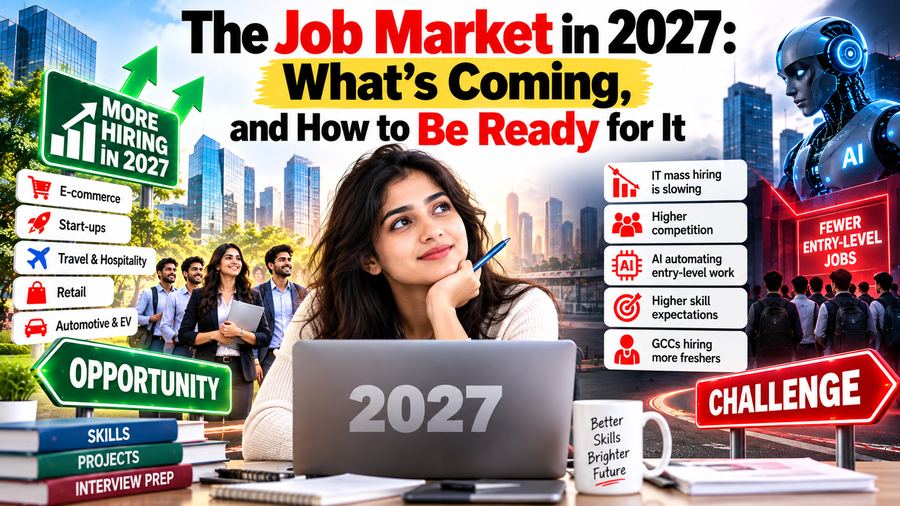
Every year brings a new "job market outlook." Most of them say the same thing: AI is changing everything, upskill or get left behind. That's not wrong, but it isn't very useful either.
So let's go deeper. After looking through the latest hiring surveys, salary studies, labour data and research on AI's effect on jobs, a clearer picture of 2027 appears. It isn't a story of boom or bust. It's a story of a split: more hiring overall, but concentrated in fewer places, for fewer kinds of candidates, with a higher bar than ever before.
Here's what's really happening, and what it means for you.
In this article
- Force #1: Hiring is growing again, but not everywhere
- Force #2: The end of the IT mass-hiring era
- Force #3: GCCs are becoming the new campus recruiters
- Force #4: AI is squeezing the entry point, not the whole market
- Force #5: India's youth job paradox
- Force #6: Pay is rising, but selectively
- The bigger picture: a decade of skill churn
- Your 2027 playbook: 8 moves that matter
- The bottom line
Force #1: Hiring is growing again, but not everywhere
Start with the encouraging news. Employers expect a 5.4% net increase in their workforce between October 2026 and March 2027, the highest reading in the last three half-year periods. 60% of employers plan to grow headcount, 24% expect no change and 16% expect to shrink.
But look closely at where that growth is. E-commerce and tech start-ups lead with a projected 12.6% net employment change, followed by travel and hospitality at 12.3%, retail at 10.3%, automotive at 10.1%, and EV and EV infrastructure at 9.7%.
The insight: the fastest-growing employers in 2027 aren't the traditional "dream companies" most graduates target. They're start-ups, consumer businesses, mobility and EV firms. Candidates who follow the growth will face less competition than those who all queue up for the same few big names.
Force #2: The end of the IT mass-hiring era
For two decades, large IT services companies were the default first job for Indian engineering graduates. That model is being rewritten in real time.
TCS started FY27 with 25,000 fresher offers, well below the roughly 44,000 it hired in FY26 and its usual 40,000-plus annual intake. Management says more hiring depends on better demand visibility. Its CEO explained the logic plainly: a fresher can take up to nine months to become productive, while an experienced hire delivers immediately.
Infosys is holding steady, planning to hire at least 20,000 freshers in FY27, the same as the previous year. But the company expects revenue growth of just 1.5% to 3.5% this fiscal, reflecting slower client decisions and reduced tech spending.
Part of the reason is AI. A growing share of entry-level work like basic coding, testing and debugging is now being handled by AI tools.
The insight: that "nine months to productivity" comment is the most important sentence in this entire article for freshers. Companies aren't rejecting freshers because they dislike them. They're rejecting the ramp-up time. Anything you can do to show you'll be productive faster (real projects, internships, familiarity with the tools teams actually use) directly addresses the biggest objection employers have.
Force #3: GCCs are becoming the new campus recruiters
While traditional IT services pull back, Global Capability Centres (the India offices of multinational companies) are stepping forward.
52% of GCCs expect to increase hiring in FY27, up from 47% the year before, and those expecting cuts dropped from 36% to 26%. GCC hiring could create about 1.5 lakh new roles in FY27.
Better yet for freshers: early-career talent makes up the biggest share of expected GCC hiring, with freshers at 16% and those with one to five years of experience at 30%, together accounting for 46%.
There's a catch, though. GCCs report a significant gap between claimed and demonstrable skills in AI and machine learning, cloud and product engineering.
The insight: GCCs want early-career talent, but they're tired of resumes that list skills candidates can't actually demonstrate. In 2027, the winning move isn't adding more buzzwords. It's proving the ones you already have.
Force #4: AI is squeezing the entry point, not the whole market
This is the force everyone talks about, but few explain well.
Global research is starting to show a clear pattern. There's no sign of widespread, economy-wide job loss from AI. But young workers in AI-exposed jobs are falling behind. Employment among 22–25 year-olds in highly exposed occupations is now about 19% below where it would be had it kept pace with less-exposed peers. Experienced workers show no such gap. And this gap is widening, from 15% in July 2025 to 19% by June 2026.
Crucially, it's happening mainly through companies hiring fewer young people, not firing existing staff.
The most useful finding explains why. Employment has fallen for young workers in jobs built on codified knowledge, the formal, documented kind you learn from textbooks and courses. Meanwhile, employment has grown for experienced workers in jobs relying on tacit knowledge, the kind you gain through practice, mentorship and real-world situations.
And one more distinction matters: declines concentrate in jobs where AI automates tasks, while in jobs where AI complements workers, employment is flat or rising.
A fair caveat: researchers still debate how much of this is AI versus other factors. The honest summary is that entry-level hiring has weakened, and AI is one of several contributing causes that haven't been fully separated yet.
The insight: this may be the single most important idea for your 2027 career strategy. Textbook knowledge is becoming cheap because AI has it too. Experience-based knowledge is becoming valuable because AI doesn't. Every hour you spend building real things, solving messy problems and working with real users builds the kind of knowledge AI can't easily replace. And aim for roles where you'd use AI as a tool, not roles where AI would simply do the job.
Force #5: India's youth job paradox
Here's the uncomfortable contradiction at the heart of 2027. Employers say they're hiring more, yet young Indians are finding it harder to get work.
Official labour data for April–June 2026 showed youth unemployment at 15.9%, up from 15% the previous quarter and 14.6% a year earlier. Graduate unemployment stood at 13% in 2023–24, higher than for those with only secondary or higher-secondary education.
How can both be true? Because employers aren't short of applicants. They're short of job-ready applicants. The demand and the supply simply don't match.
The insight: a degree alone no longer separates you from the crowd, because almost everyone competing with you has one. What separates you is everything beyond the degree.
Force #6: Pay is rising, but selectively
For those who land jobs, pay prospects look steady. Average salary increments for FY27 are projected at 8.6% to 10.2% across 23 industries, a narrower range than last year's 6.2% to 11.3%. Corporate India's overall increment is expected at about 9.1%.
EV and EV infrastructure, real estate and infrastructure, and NBFCs top the list, each projected at around 10% to 10.2%. Meanwhile, pure-play IT services firms are expected to raise salaries more slowly than almost every other sector.
Location matters too. Chennai leads salary growth at 9.7%, followed by Pune and Hyderabad at 9.6% and Ahmedabad at 9.5%, with non-metro cities like Visakhapatnam and Nagpur also gaining.
The insight: rising pay follows specialised, hands-on skills. The biggest gains are going to execution-heavy roles in engineering, quality, safety and field support. If you're choosing between a generic role and a specialised one, the specialised path increasingly pays off.
The bigger picture: a decade of skill churn
Zoom out and 2027 is just one stop on a longer journey. Globally, 170 million new jobs are expected to be created and 92 million displaced by 2030, a net gain of 78 million. But nearly 40% of job skills are expected to change over that period.
The fastest-growing skills? AI and big data top the list, followed by networks and cybersecurity, then technological literacy, creativity, and resilience, flexibility and agility.
Notice something? Half of that list is technical. The other half is deeply human. The future belongs to people who combine both.
Your 2027 playbook: 8 moves that matter
Here's how to turn these forces into a practical strategy.
1. Attack the "ramp-up time" objection. Employers hesitate on freshers because training takes months. Show them you'll need less. Build projects using real-world tools like Git, cloud deployment, CI/CD, APIs and databases. An internship, even a short one, is proof you've already worked in a real team.
2. Build tacit knowledge on purpose. Don't just finish courses. Build messy, real things. Freelance for a local business. Contribute to open source. Help a start-up. Every real problem you solve builds the experience-based knowledge that AI can't copy.
3. Prove skills, don't just list them. With employers openly frustrated by the gap between claimed and real skills, every skill on your resume should link to evidence: a project, a certificate with real work behind it, a GitHub repo, a result.
4. Choose AI-complemented roles. Target roles where AI makes you more productive rather than roles AI can do alone. A developer who designs systems and uses AI to code faster is valuable. A role that's only writing boilerplate code is at risk.
5. Follow the growth, not the crowd. E-commerce, start-ups, EV, mobility, retail tech and GCCs are expanding. Don't limit yourself to the handful of companies everyone else is applying to.
6. Look beyond the big metros. Salary growth and hiring are spreading to cities like Chennai, Pune, Hyderabad, Ahmedabad and emerging tier-2 hubs. Being open to relocation widens your options significantly.
7. Develop the human skills AI can't replicate. Communication, problem-solving, adaptability and working well in global teams are increasingly what separate candidates with similar technical skills, especially at GCCs, where you'll often work with international colleagues.
8. Make every application count. With intense competition for every opening, generic applications disappear. Tailor your resume to each role, lead with your most relevant proof, and match the language the employer uses.
Put move #8 on autopilot: Resume Minter compares your resume against any job description and shows exactly which skills and keywords are missing, so tailoring takes minutes instead of hours.
The bottom line
2027 won't be the year jobs disappear. It'll be the year the job market fully separates into two groups: candidates who claim skills, and candidates who prove them.
The opportunities are real. Hiring is growing, GCCs are expanding and new sectors are opening up. But they'll go to those who show up ready, specialised and able to demonstrate their value from day one.
Start preparing now, and 2027 could be your year.
Keep reading
Show employers what you can actually do
In a market where proving your skills matters more than listing them, your resume has one job: show the right evidence for the right role, every single time. Tailor each application in minutes with Resume Minter, no signup required.
Check my ATS score Build my resume